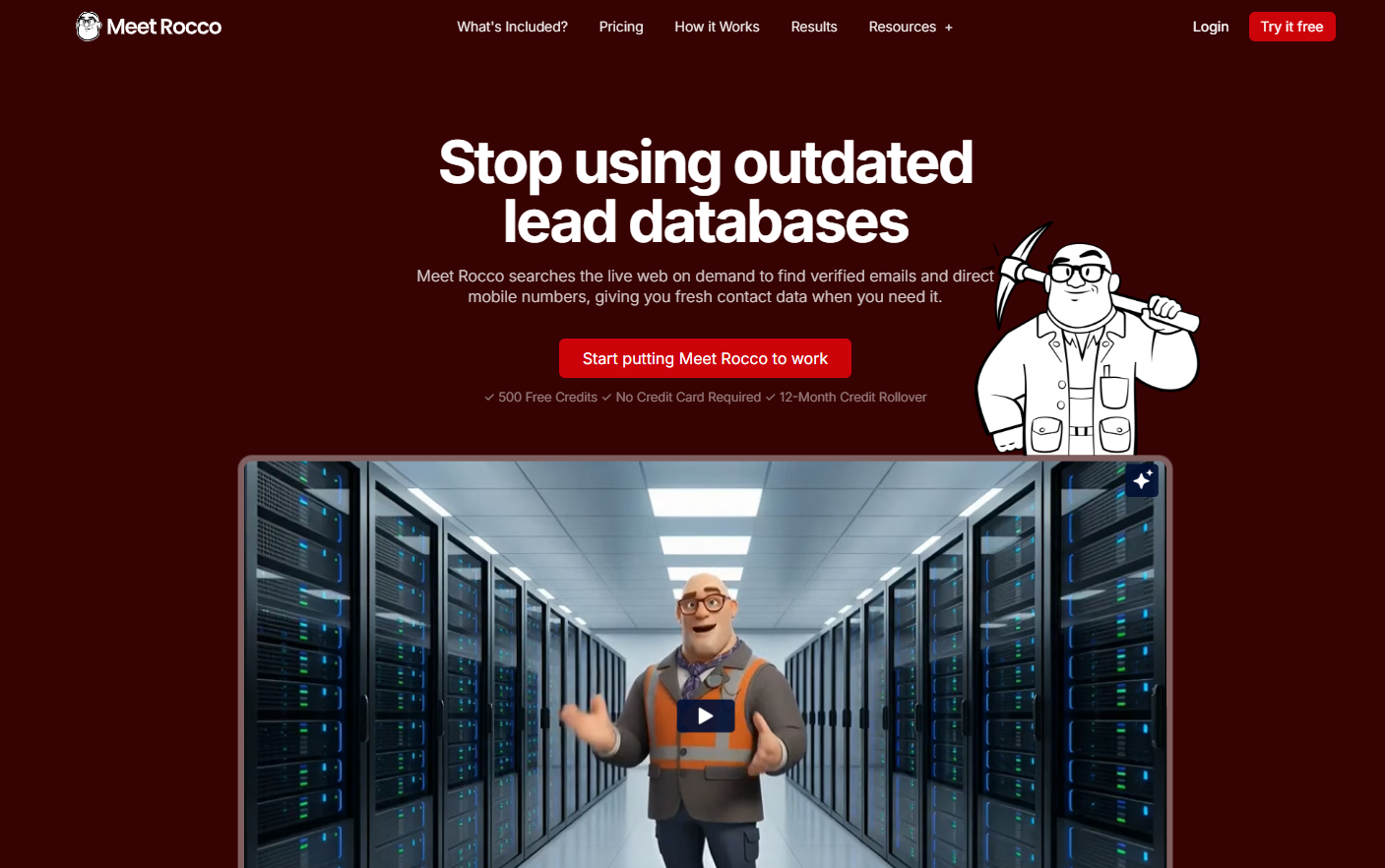
Our top Lusha alternative for 2026 is Meet Rocco, which looks up emails and mobile numbers on the live web at search time and charges outbound teams and agencies per reveal, starting with 500 free credits.
RocketReach and UpLead are the closest fits for lookups on a published self-serve plan, and UpLead counts a contact's email and mobile direct dial as a single credit.
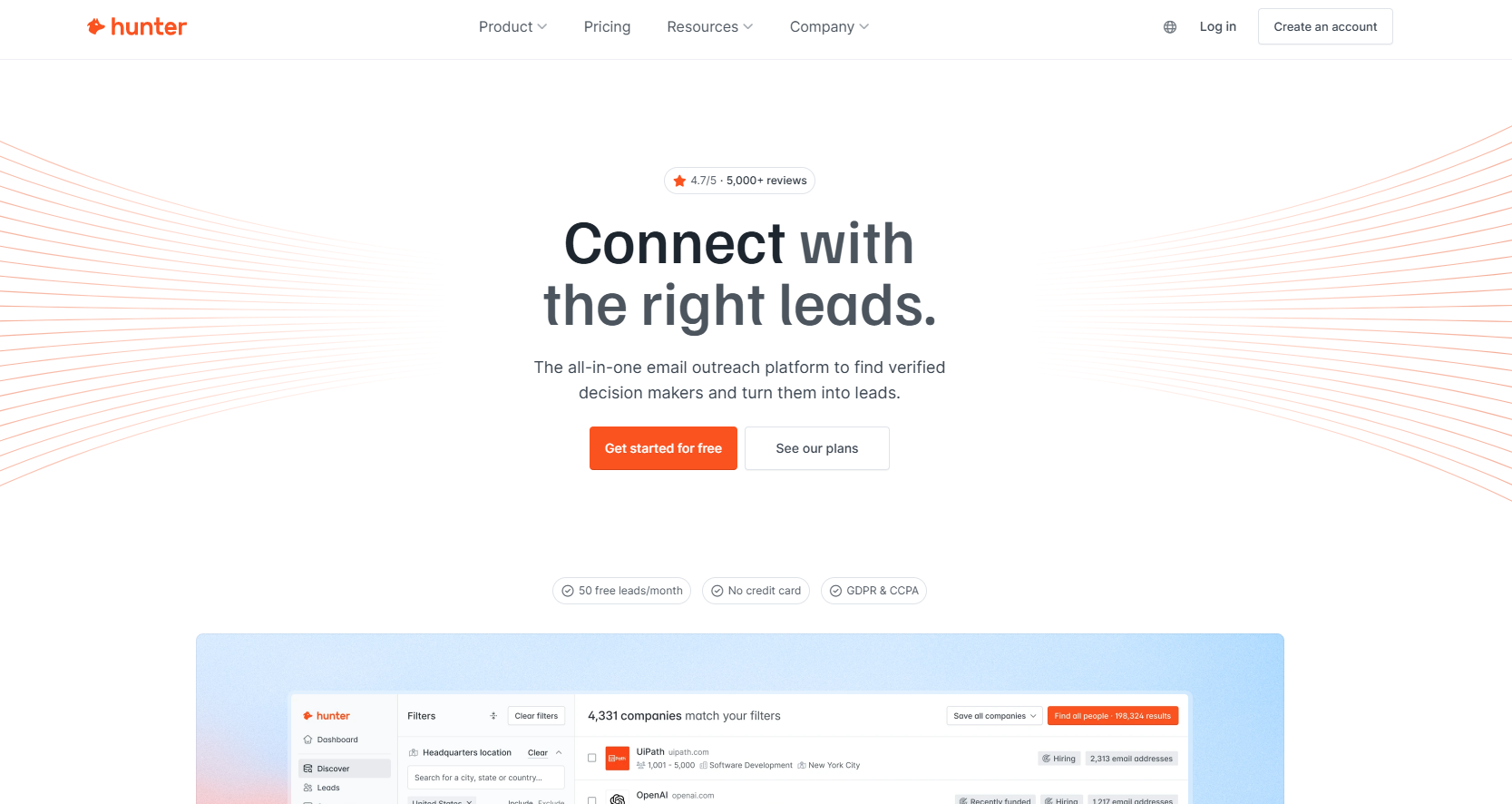
Apollo.io, Seamless.AI, Saleshandy, and Hunter bundle contact data with email outreach. LeadDelta is built for sellers who prospect mainly through their own and their team's LinkedIn connections.
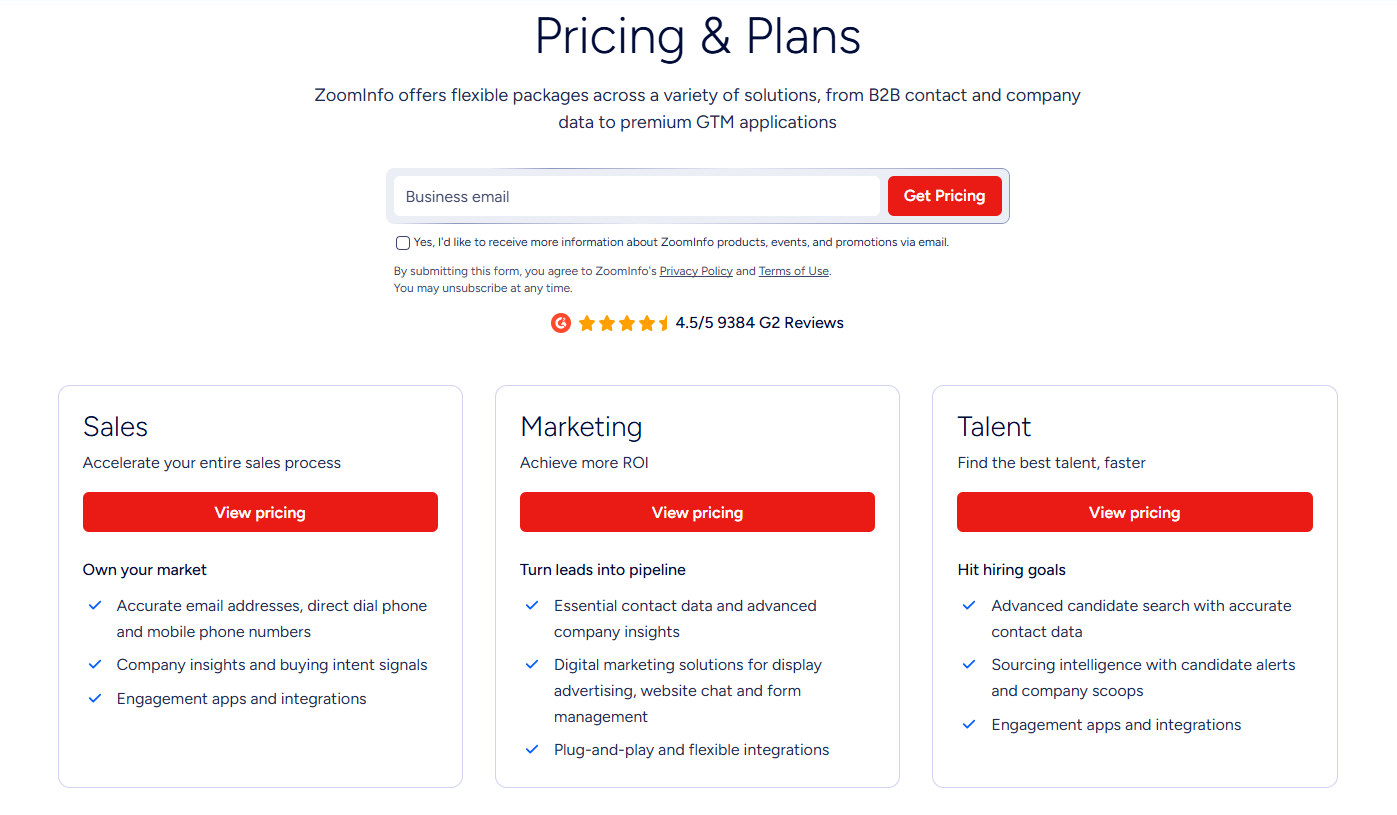
ZoomInfo and Cognism are sold by quote and attach intent data and signals to each contact record.
Lusha sells verified emails and direct dials on published credit plans, with a free plan to start, though teams might look for an alternative once their needs go beyond what their Lusha plan covers.
The 10 Lusha alternatives below are each matched to the buyer they suit best, with every price checked on the vendor's own website.
What are the best Lusha alternatives in 2026?
Meet Rocco is the best Lusha alternative in 2026 because it finds contact data on the live web at the moment you search and bills per reveal, with no seat tiers.
Apollo.io follows for sales teams that need outreach in the same subscription, and ZoomInfo for enterprise intent data.
Here’s the full shortlist:
Tool
Best for
Where the data comes from
Starting price
Meet Rocco
Outbound teams and agencies paying per reveal, without seats or an annual contract
Live web search, run when you search
Free trial with 500 credits; Starter $25/month; pay-as-you-go packs
Apollo.io
Sales teams that want data, sequences, and a dialer on one per-seat plan
240M+ contacts and 30M+ accounts, plus waterfall enrichment
Free plan; Basic $49/seat/month on annual billing
ZoomInfo
Mid-market and enterprise GTM teams buying contacts, intent, and account intelligence from a single vendor
Contact and company database enriched with firmographic, technographic, and intent data
Quote only; free trial
Cognism
Revenue teams that call into Europe and need phone-verified mobiles alongside signals
Pre-built records from automated web research and validated third-party sources, each scored for confidence
Quote only; free data sample
Seamless.AI
Reps who want real-time search with email and calling built in
Real-time search engine over 1.6B+ verified business emails and 448M+ phone numbers
Free plan with 50 credits; Pro by quote
UpLead
Small teams paying one credit per contact for both the email and the mobile direct dial
200M+ leads, verified by AI at search time and sorted by freshness
Essentials $99/month; seven-day trial with five credits
Saleshandy
Founders, SDRs, and agencies sending cold email from the platform that holds their leads
852M+ contacts, enriched through a waterfall of providers
Starter $34/month on annual billing; seven-day trial
RocketReach
Reps and small teams looking up specific, named people
700M+ professional profiles at 60M companies
Essentials $19/month on annual billing
Hunter
Email-led prospecting with cold email sequences in the same tool
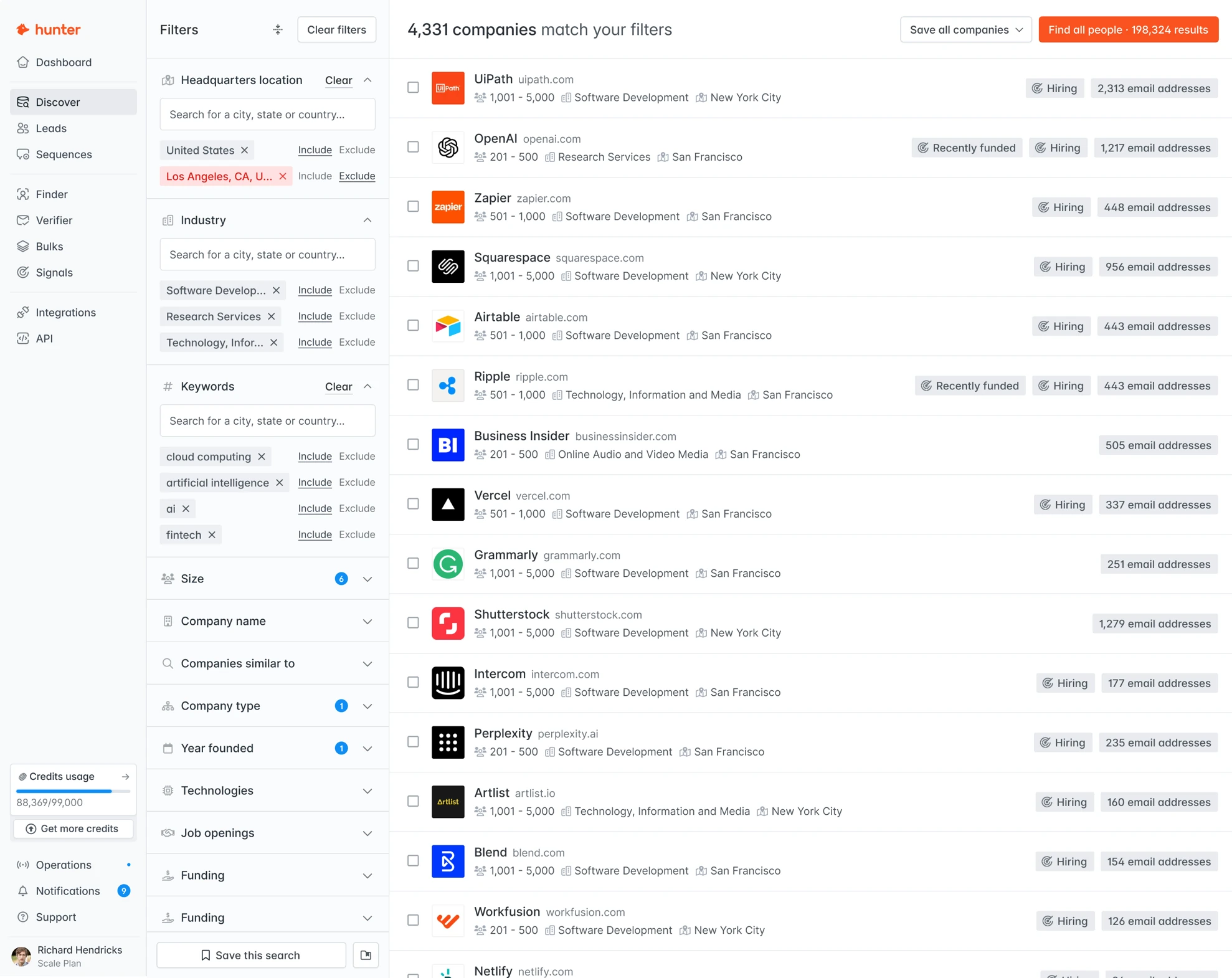
Discover database, Domain Search, and Email Finder, with email verification
Free plan with 50 credits/month; Starter €34/month on yearly billing
LeadDelta
LinkedIn-first sellers working their own and their team's networks
Synced LinkedIn connections, waterfall email and phone finding, and LeadSearch across 500M people
Starter $17.50/user/month on yearly billing; seven-day trial
How did we choose these Lusha alternatives?
We shortlisted tools that find, verify, or enrich B2B emails and phone numbers for the same buyers Lusha targets, then reviewed each one on five points:
Contact data: whether the tool returns verified emails, mobile numbers, and direct dials, and what a phone reveal costs in credits compared with an email.
Data source: a compiled database, a real-time search, a multi-provider waterfall, or the user's own LinkedIn network.
Buying model: public price or quote, how seats are counted, billing terms, and any free plan or trial.
Signals and workflow: intent, job changes, CRM enrichment, and whether outreach happens in the same product.
Team fit: SDR teams, founders, agencies, RevOps, or enterprise GTM.
Note: Kaspr is not on the list because it is a Cognism company and Cognism already has an entry. AI outreach agents that don't sell contact data were also left out.
#1: Meet Rocco
Meet Rocco is our top Lusha alternative for 2026. It suits outbound teams and agencies that want each contact found on the live web at search time and paid for one reveal at a time, with no seat tiers or yearly plan.
A note on bias: Meet Rocco is our own platform. I'll still give you an even-handed look at why we rank it as the best Lusha alternative on the market in 2026.
As a lead generation and contact data platform, Meet Rocco searches the web on demand for every query.
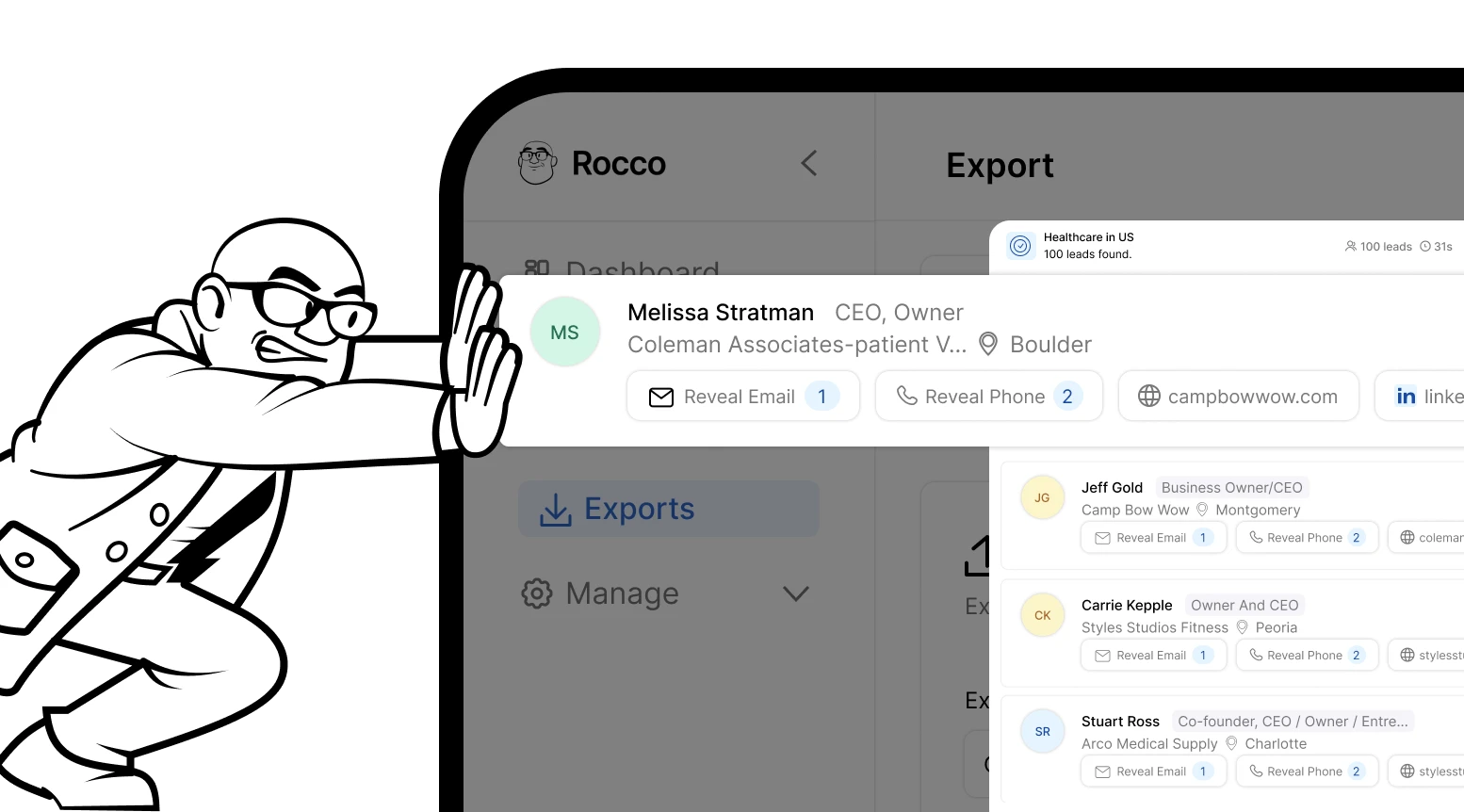
You see the companies and buyers that match your filters on the day of the search, then unlock verified emails and direct mobile numbers for the contacts you pick.
How does Meet Rocco work? From target to export
A Meet Rocco prospect list takes four steps, from a description of your ideal buyer to an export:
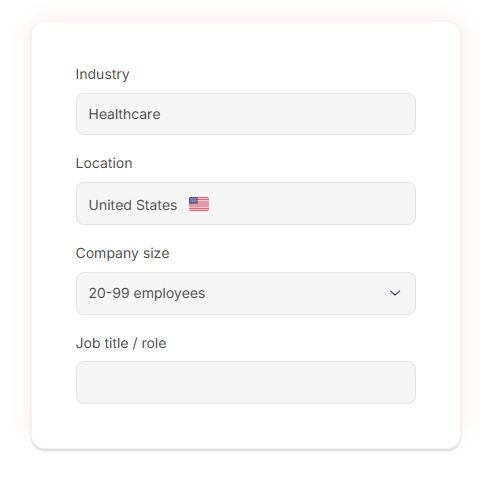
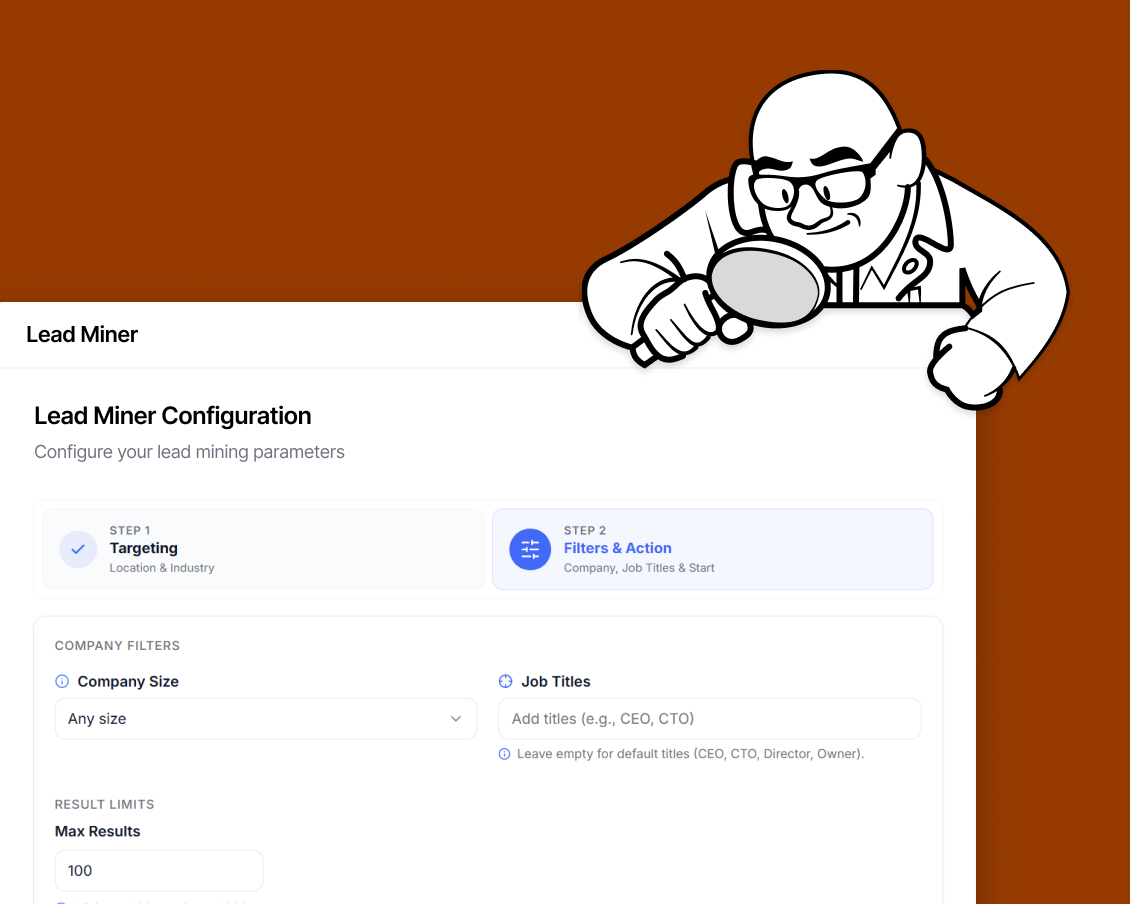
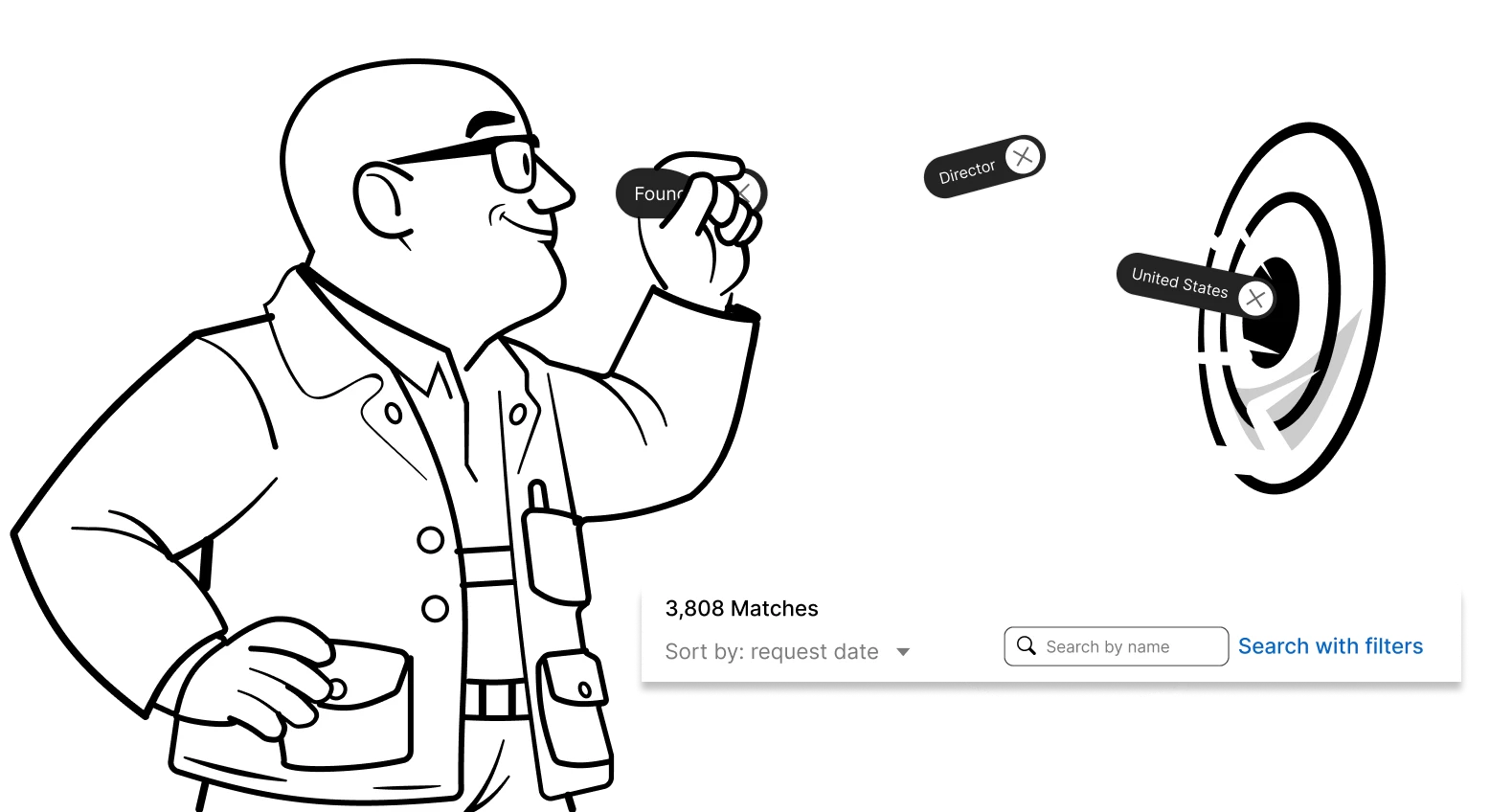
Define your target: You start by setting filters for industry, location (country, region, or city), company size, revenue, job title or role, and seniority.
Meet Rocco mines the web: A live query runs across the web using Meet Rocco's own technology and returns the profiles that match.
Review and select: Check each result for fit and pick the people worth contacting. Reviewing results costs no credits.
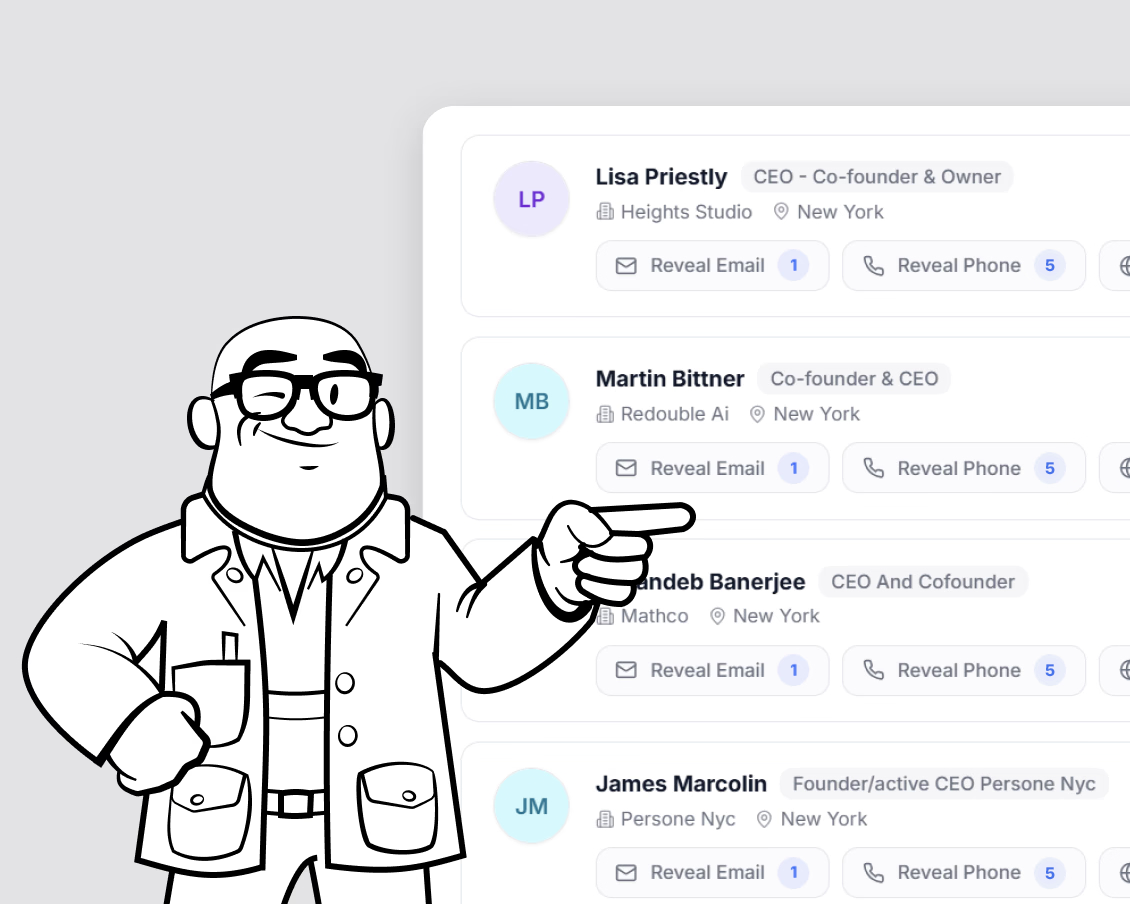
Unlock contact data: Use credits to reveal emails and phone numbers for the leads you picked, then export them for outreach.
Live web search at query time
Each Meet Rocco query runs against the live web at the moment you submit it. Results reflect what is published that day, so recent job changes are more likely to show up.
We built Meet Rocco this way because job changes are a frequent cause of bad contact data in outbound.
When a compiled dataset was last refreshed before someone switched employers, that person can still be listed at the old company, and the error shows up later as a bounced email or a wrong number.
Since the search happens at query time, Meet Rocco can also reach people at newer companies and in niche segments that a compiled database may not have indexed yet.
Company and buyer search in one flow
Meet Rocco starts each search with accounts. You get the companies that fit your filters first, then the decision-makers inside each one, narrowed by role and seniority.
💡 As accounts and contacts come out of the same search, you can trim the company list before spending any credits on people.
Verified emails and direct mobile numbers, unlocked per contact
For each contact, Meet Rocco can return a verified email, a phone number, a LinkedIn profile, and company details. Credits are charged only for the email and phone reveals you select.
An email reveal costs one credit, and a phone or mobile reveal costs five, the same ratio Lusha uses.
At that ratio, you can unlock emails for a whole list cheaply and save phone reveals for the accounts your reps will call.
Export to your CRM or outreach tool
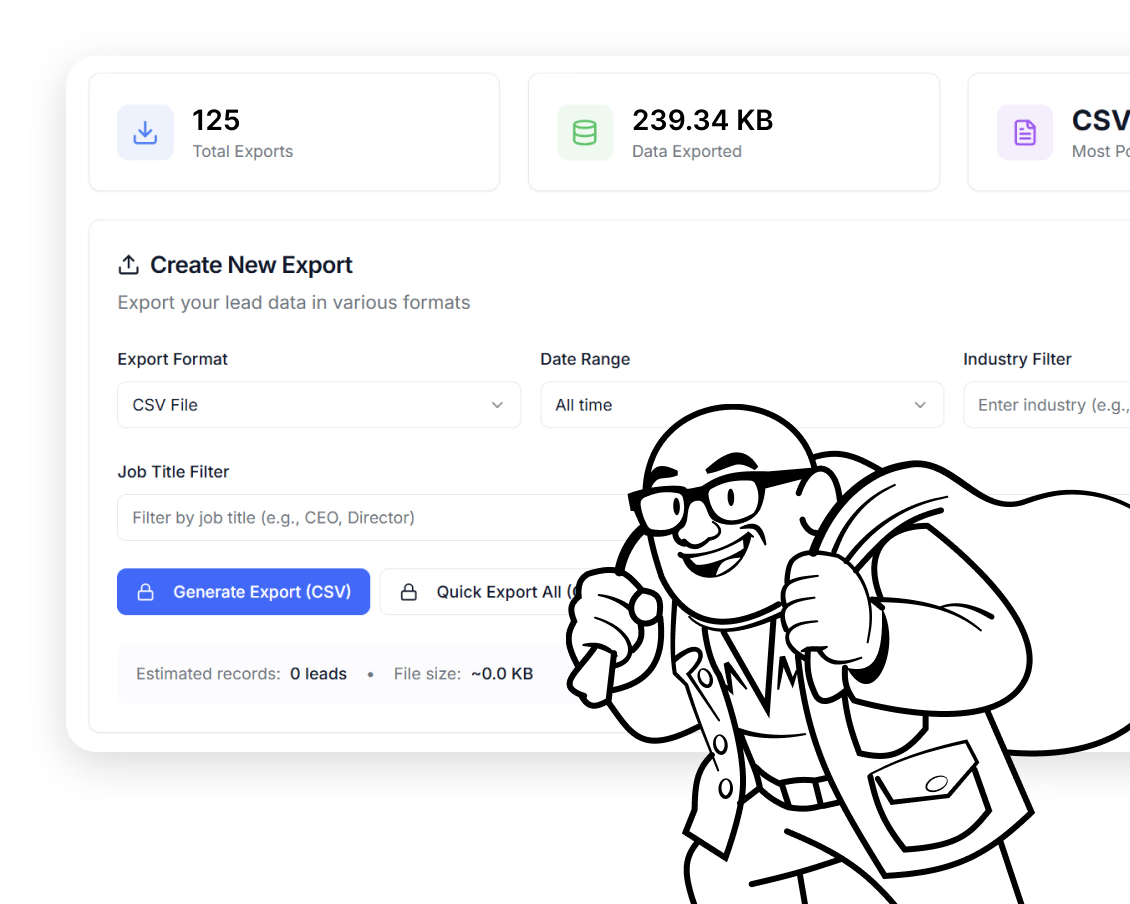
A finished list exports from Meet Rocco in one click, as a CSV or PDF file for your CRM or email sequencer.
➡️ Meet Rocco doesn't send outreach itself. For a sequencer from the same product family, Meet Alfred can take the exported list and run LinkedIn, email, and X campaigns.
What makes Meet Rocco different from Lusha?
The main difference is the data source.
Meet Rocco searches the live web each time you run a query, and Lusha draws on a compiled database of 525M+ contacts and 29M+ companies.
Both charge one credit per email and five per phone, so the other differences come from how each tool is built and sold:
Lusha: records come from professional communities, partners, and vetted contributors and are cross-checked against several independent sources. Deep Intelligence then scores accounts against your ICP, CRM data, and closed-won deals.
Meet Rocco: credits are sold self-serve, on a monthly plan or pay-as-you-go, and purchased credits stay valid for 12 months.
Here is how the two compare head-to-head:
Criteria
Lusha
Meet Rocco
Data source
Compiled database of 525M+ contacts and 29M+ companies, cross-checked against several independent sources
Live web search each time you run a query
How you buy
Self-serve plans, with 25% off for yearly billing; Scale by custom quote
Self-serve sign-up, monthly plan or pay-as-you-go
Seats
One seat on Free and Starter, two on Pro, five on Premium, and custom on Scale
Plans priced by credits, with team invitations and per-member credit limits on Team Workspace
Credit use
One credit per verified email and five per phone number
One credit per email and five per phone or mobile number
Credit validity
Yearly plans grant credits upfront; Pro and Premium roll over unused monthly credits up to a 2x monthly cap
Purchased credits stay valid for 12 months; unused subscription credits roll over automatically
Free way to start
Free plan with 40 credits per month and one seat
500 free credits, no credit card
Signals
26 buying signals refreshed weekly, such as funding, hiring surges, job changes, and leadership moves, from the Pro plan, plus buying intent topics from Starter
Firmographic, role, and seniority filters at search time
CRM enrichment and API
Salesforce, HubSpot, monday, and Zoho integrations, plus the Lusha API, the Lusha MCP, and Data Waterfall from Pro
CSV and PDF export
If I were choosing between them today:
Lusha is the better pick if your team works in Salesforce or HubSpot and needs records enriched there automatically and ranked by buying signals.
Go with Meet Rocco if you'd like every search run on the live web and to pay only for the contacts you unlock, including people a compiled database may have missed.
Meet Rocco pricing
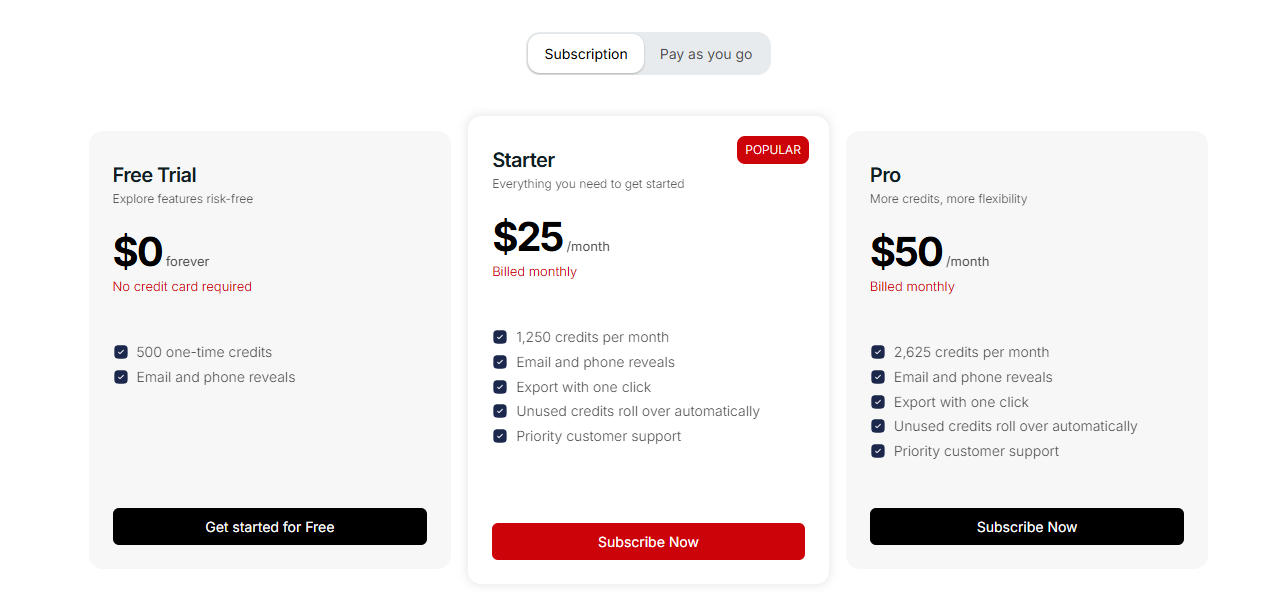
New Meet Rocco accounts start on a free trial with 500 one-time credits and no credit card. After the trial, you can choose a monthly subscription or a team plan, or buy credit packs as you go.
Free Trial: $0 for 500 one-time credits, usable on email and phone reveals.
Starter: $25/month, billed monthly, for 1,250 credits a month, with one-click export, automatic rollover of unused credits, and priority customer support.
Pro: $50/month, billed monthly, for 2,625 credits a month and every Starter feature.
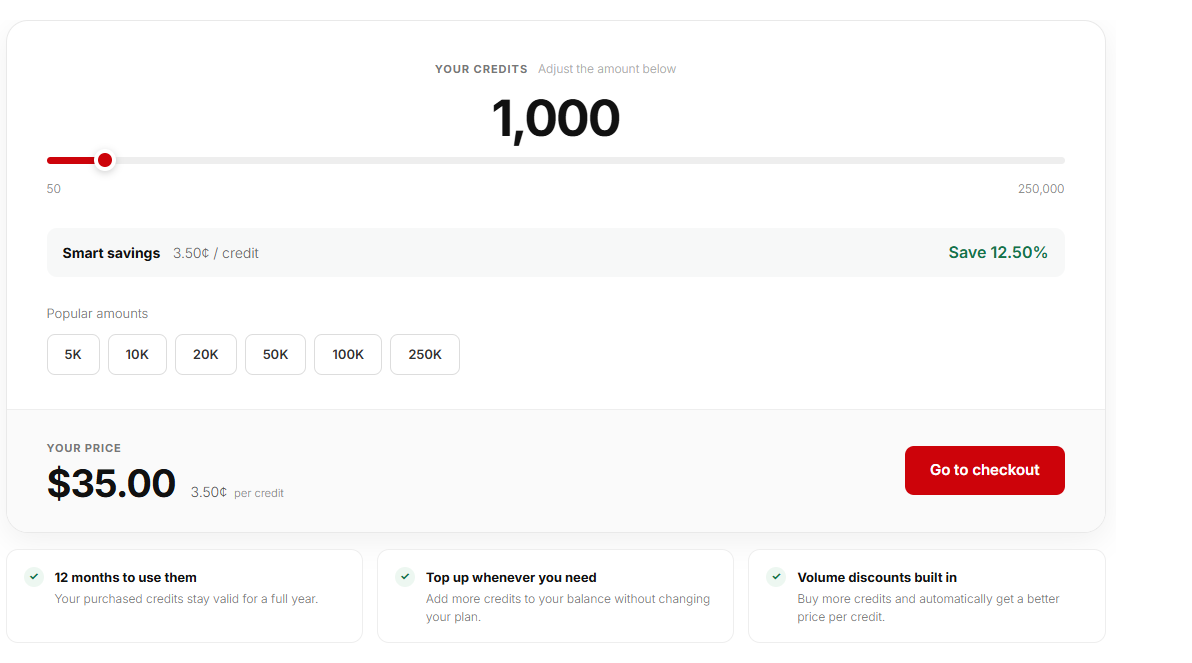
Pay as you go: any amount from 50 to 250,000 credits, with volume discounts built in. A 1,000-credit purchase costs $35, or 3.5¢ per credit.
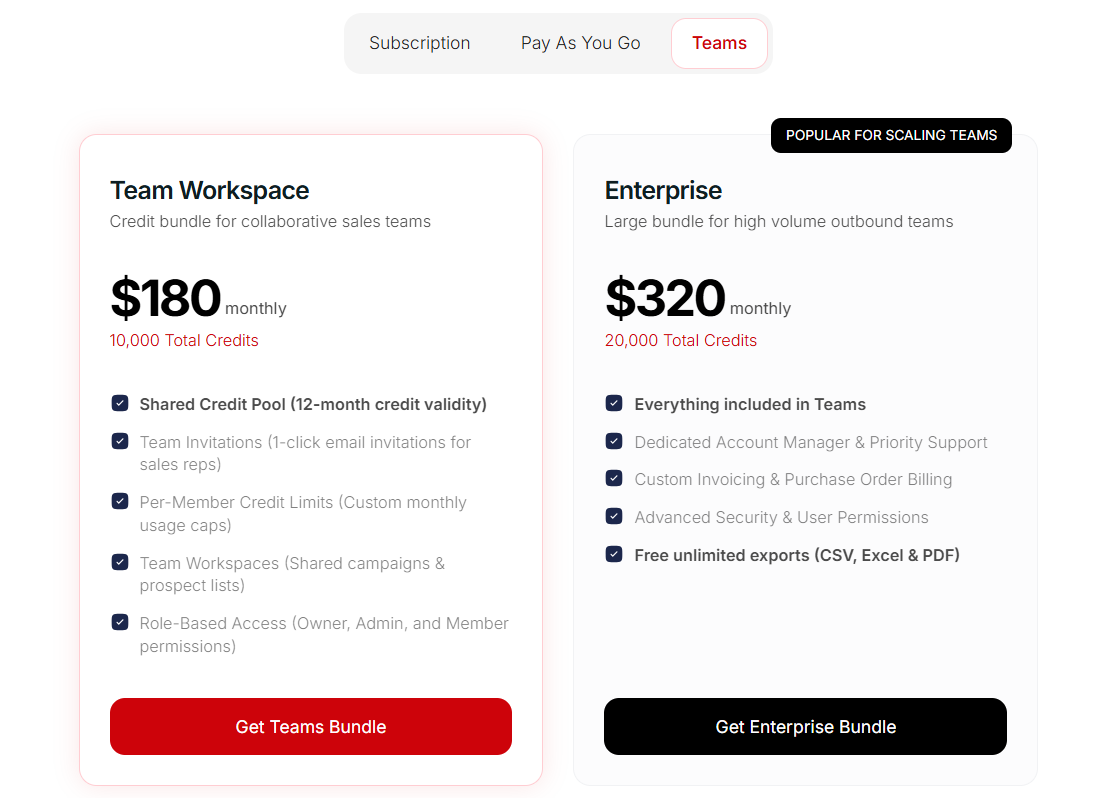
For teams, Meet Rocco has two more plans:
Team Workspace: $180/month for 10,000 total credits, with team invitations, per-member credit limits, shared campaigns and prospect lists in team workspaces, and role-based access.
Enterprise: $320/month for 20,000 total credits, with a dedicated account manager, priority support, custom invoicing and purchase order billing, advanced security, user permissions, and free unlimited exports in CSV, Excel, and PDF.
💡 Purchased credits remain valid for 12 months from the purchase date.
Meet Rocco pros and cons
✅ Contact data comes from a live web search at the moment you run it.
✅ You pay in credits, monthly or as you go, with no seats or annual contract.
✅ The 500 free credits need no credit card and cover enough reveals to test lead quality on your own ICP.
✅ Unused subscription credits roll over, and purchased credits last a full year.
❌ Outreach needs a separate tool, because Meet Rocco has no built-in sequencer, dialer, or CRM.
❌ With no native CRM sync yet, so lists reach other tools through CSV or PDF export.
#2: Apollo.io
Best for: Sales teams that want contact data, sequences, and a dialer on one per-seat subscription.
Apollo.io is a GTM platform whose B2B database holds 240M+ contacts and 30M+ accounts.
From that data, Apollo's AI agents research accounts and draft outreach, and reps handle the sequences and calls inside Apollo.
Apollo.io features
Apollo Data: 240M+ contacts and 30M+ accounts under continuous refresh, with waterfall enrichment to fill missing fields.
Buying signals: intent, job changes, and website visits. Free includes one intent topic, Basic and Professional include six, and Organization includes 12.
GTM Harness and AI Context Center: where you give Apollo's agents context on your market and how your team sells, so the agents can move prospecting from a goal to a booked meeting.
Workspace and Apollo Anywhere: Workspace covers prospecting, sequences, and calling. Apollo Anywhere takes the same data into ChatGPT, Claude, Gmail, your CRM, and the browser, backed by 200+ integrations and a deliverability suite with domain warming and inbox rotation.
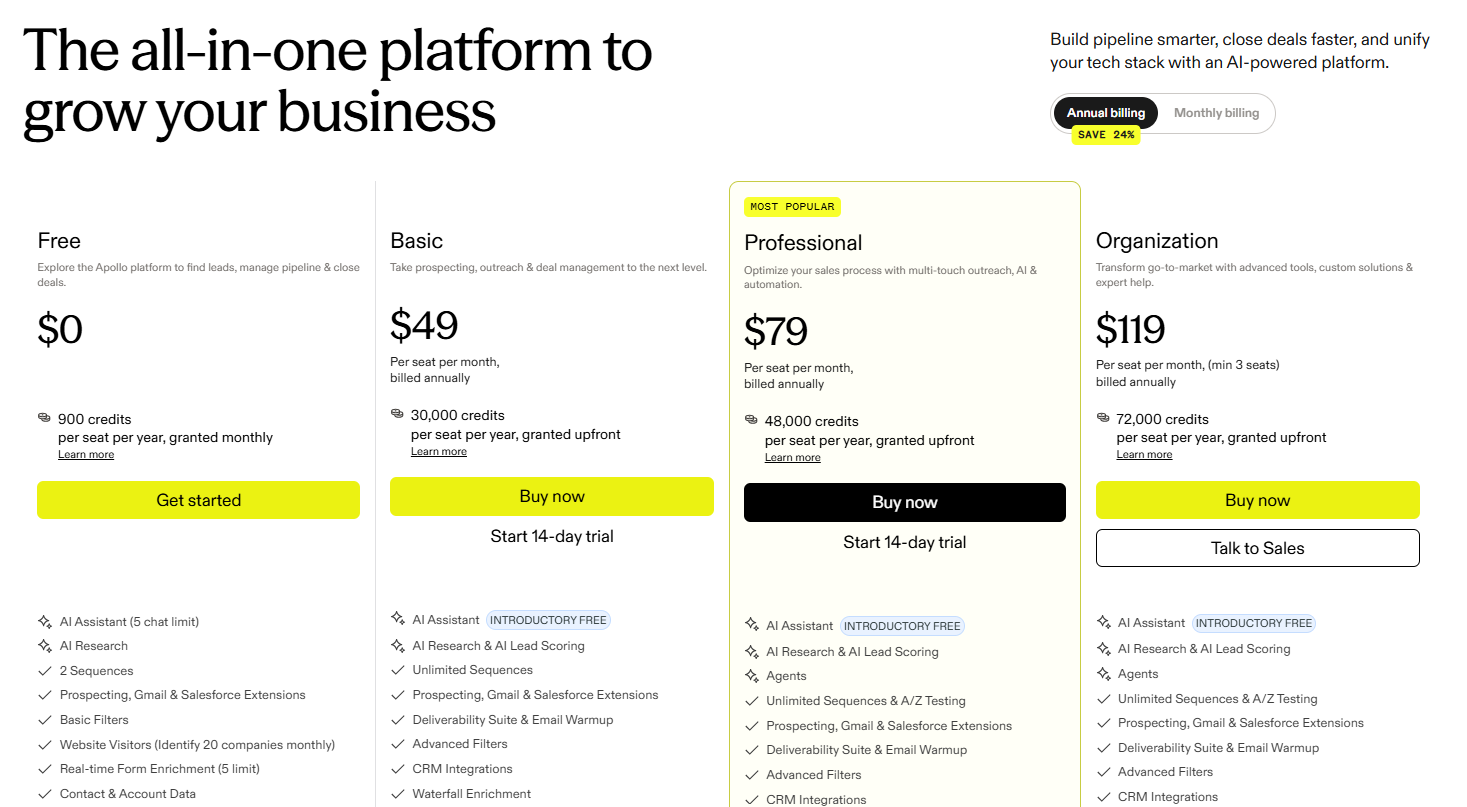
Apollo.io has four plans, one of them free, and Apollo puts the annual billing discount on paid tiers at 24% compared with monthly billing.
Free: $0, with 900 credits per seat per year (granted monthly), two sequences, and basic filters.
Basic: $49/seat/month on annual billing. Each seat receives 30,000 credits a year upfront, along with unlimited sequences, waterfall enrichment, and CRM integrations.
Professional: $79/seat/month on annual billing, with 48,000 credits per seat per year. Agents, A/Z testing, unlimited mailboxes, and 4,000 minutes of call recording with AI insights come with this tier.
Organization: $119/seat/month on annual billing, with a three-seat minimum and 72,000 credits per seat per year. SSO, customizable reports, and 12 intent topics are added.
Apollo.io pros and cons
✅ Data, sequences, dialing, meetings, and deal management share one login.
✅ Each free seat comes with 900 credits a year, so a small team can trial Apollo.io at no cost.
✅ Through Apollo Anywhere, the same data appears in ChatGPT, Claude, Gmail, and the CRM.
❌ Cost goes up with every seat you add, and Organization starts at three seats.
❌ A phone number uses eight credits, compared with one for an email.
#3: ZoomInfo
Best for: Mid-market and enterprise GTM teams that buy contact data, buyer intent, and account intelligence from one vendor through a sales-led process.
Similar to: Cognism, Apollo.io.
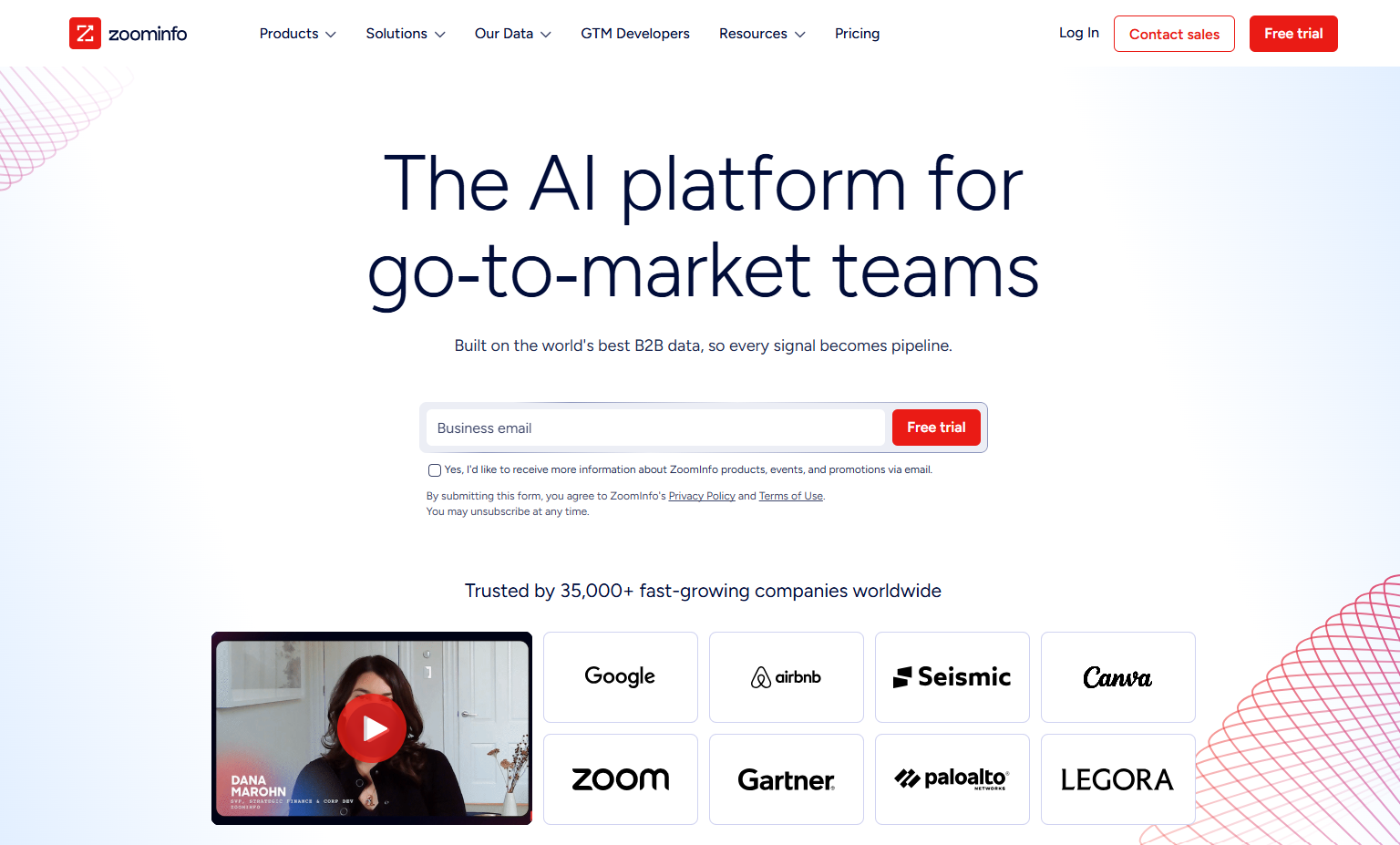
ZoomInfo provides B2B data to sales, marketing, and talent teams at more than 35,000 companies.
Its contact database is enriched with firmographic, technographic, and intent data, and Copilot features help reps rank which accounts to work first.
ZoomInfo features
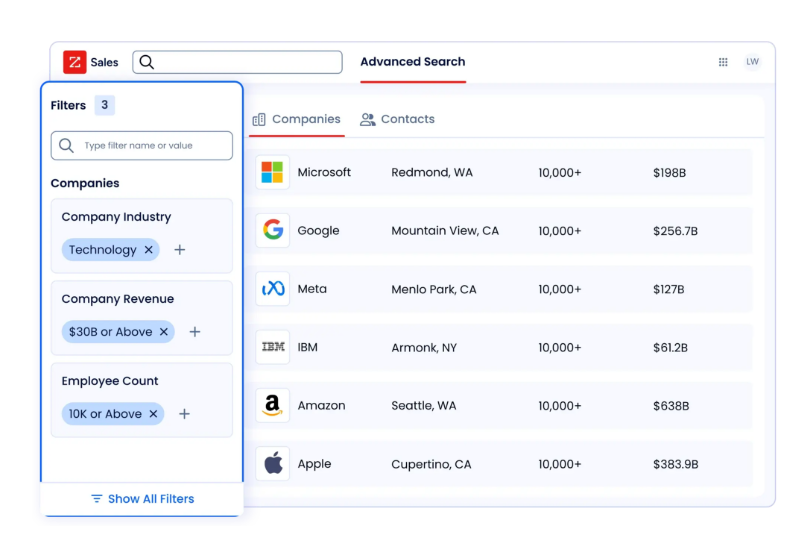
Contact and company data: business emails, mobile numbers, and direct dials, found through quick or advanced search. Reps can save prospect lists and alerts, and territory filters compare records with what is already in the CRM.
Copilot: Copilot Advanced brings AI account prioritization, buyer intent clusters, champion tracking, and AI-generated buying groups and talking points. Copilot Enterprise adds AI account summaries and Copilot chat.
Data management beyond the CRM: contact and company records are enriched and cleaned across connected systems, including tools outside the CRM.
Engagement and integrations: a Chrome extension, a mobile app, AI email generation, and intelligent dialing. Chorus handles conversation intelligence, and integrations cover Salesforce, HubSpot, Outreach, Slack, and Gong.
ZoomInfo pricing
ZoomInfo doesn't publish a price list. Any package can be quoted after you submit a business email, and a free trial is available.
The sales side comes in three packages:
Professional: contact and company profiles, mobile numbers and business emails, CRM integrations, the Chrome extension, AI email generation, and standard support.
Copilot Advanced: everything in Professional, plus account prioritization, Account Fit Score, buyer intent signals, website visitors, job posting changes, and automated workflows.
Copilot Enterprise: adds real-time buyer intent, custom intent signals, earnings call signals, competitor alerts, and advanced reporting, along with a dedicated customer service manager and white-glove onboarding.
Check out our ZoomInfo vs Meet Rocco comparison to learn more about how the 2 platforms stack up.
ZoomInfo pros and cons
✅ One vendor supplies contacts, intent, signals, and conversation intelligence.
✅ Salesforce, HubSpot, Outreach, and other major sales tools connect natively.
✅ The free trial gives hands-on access ahead of any pricing talks.
❌ Budgeting needs a sales conversation, because prices aren't public.
❌ Intent signals, workflows, and AI account summaries only come with a Copilot package.
#4: Cognism
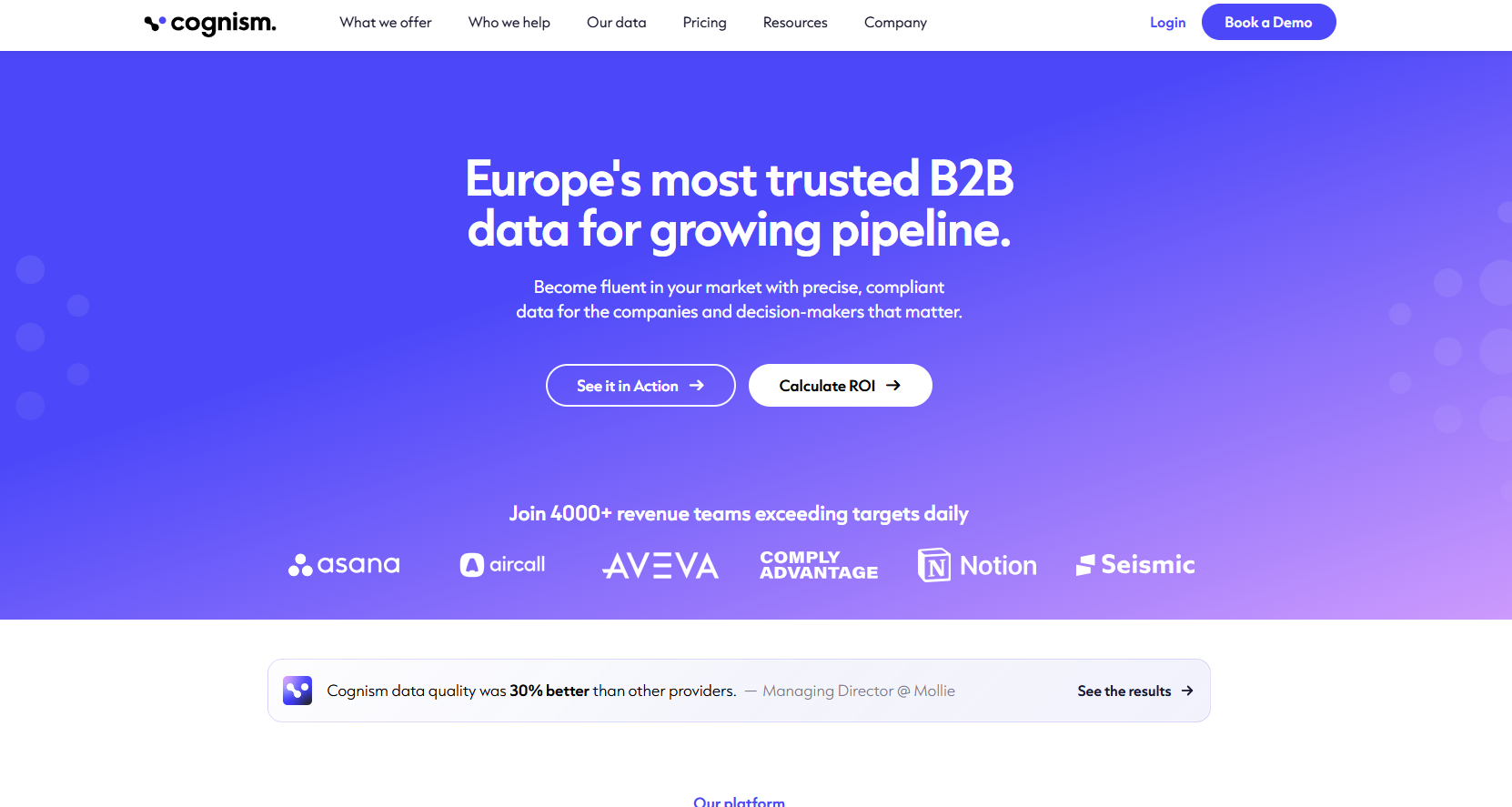
Best for: Revenue teams calling into European markets that need phone-verified mobile numbers, signals, and CRM enrichment under one quoted contract.
With a focus on European data, Cognism provides phone-verified B2B contacts to 4,000+ revenue teams.
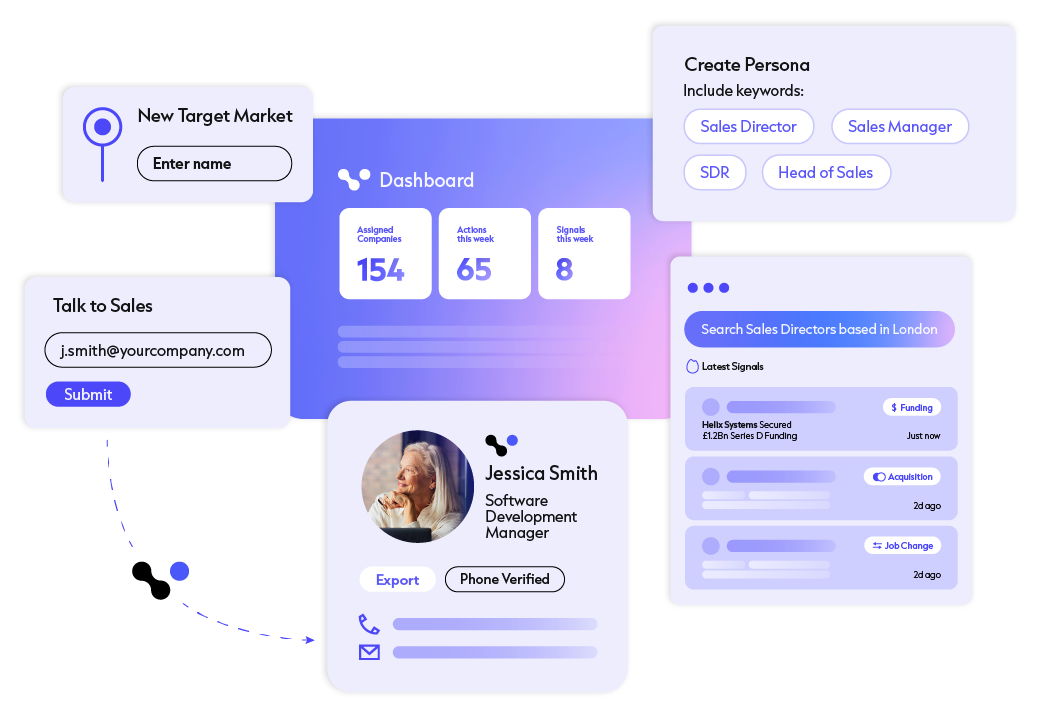
Cognism's Sales Intelligence platform adds signals such as hiring and funding to those contacts, so reps can see which accounts to call and when.
Cognism features
Sales Intelligence: suggested contacts for each account and phone-verified data, with filters for segmenting target accounts and assigning them across the team.
Scoring and matching: Cognism's AI gives every data point a confidence score, based on automated web research across press releases, company websites, news articles, earnings releases, and public registries, and on validated third-party sources.
Signals: hiring trends, funding alerts, M&A alerts, technographics covering 20,000+ technologies, and intent topics tied to research in your product category.
CRM Enrichment: enriches and maintains CRM records, either alongside Standard or Pro or as a standalone product, and charges another credit for a record only after a major change, such as the contact moving jobs.
AI and integrations: AI company research, the AI persona builder, AI search, and MCP & API access, with exports to Salesforce, HubSpot, Pipedrive, and other CRMs.
Cognism pricing
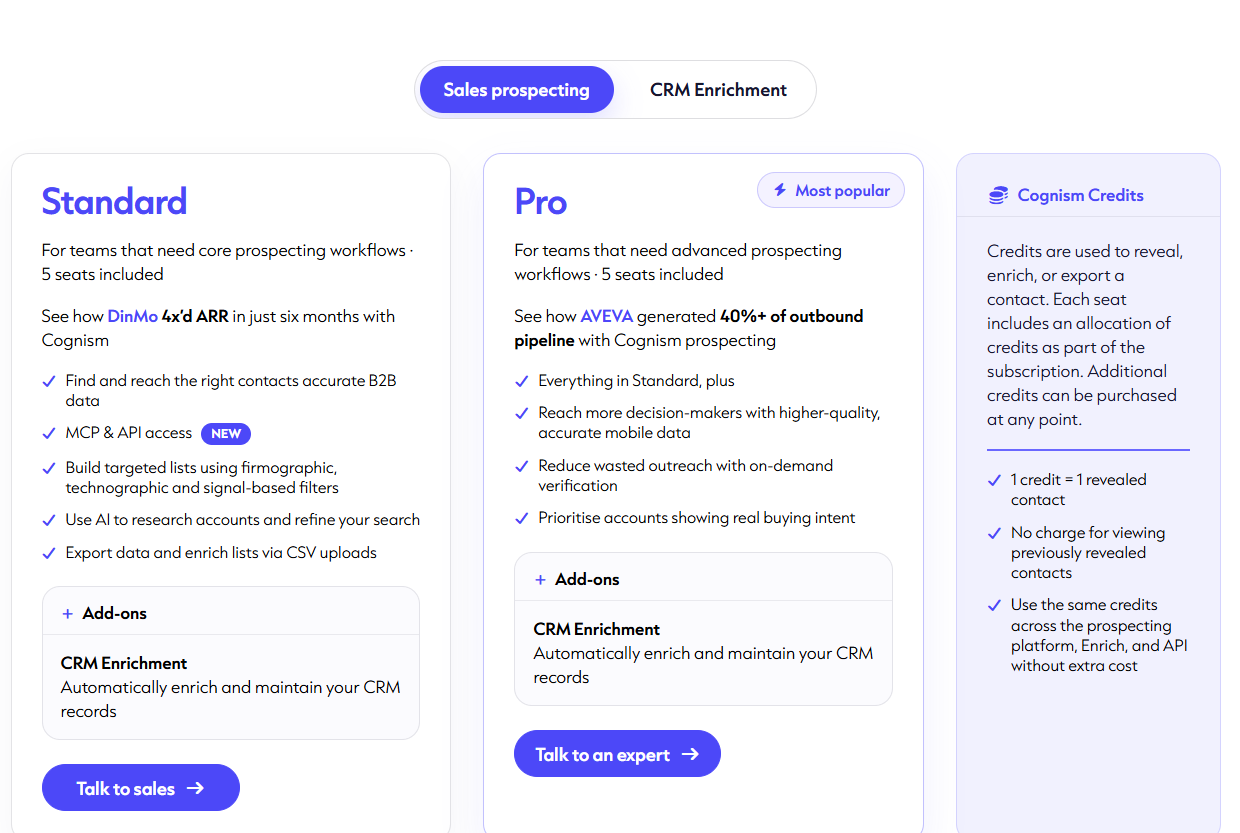
Cognism quotes both of its Sales Prospecting packages through the sales team, and each includes five seats:
Standard: core prospecting, with MCP & API access, list building on firmographic, technographic, and signal-based filters, AI account research, and CSV export and enrichment.
Pro: everything in Standard, plus higher-quality mobile data, on-demand mobile verification, and Bombora Company Surge intent data with up to 12 topics.
Every seat includes a credit allocation, where one credit reveals one contact. More credits can be bought at any point.
CRM Enrichment is sold as an add-on or as a standalone product, and Cognism also offers a free data sample and an interactive product tour.
Cognism pros and cons
✅ Mobile numbers are phone-verified, and Pro adds on-demand mobile verification.
✅ Reopening a contact you've already revealed costs nothing.
✅ A single credit balance serves prospecting, Enrich, and API calls.
❌ Costs are only known once Cognism's sales team sends a quote.
❌ Standard leaves out intent data and premium mobile data, which come with Pro.
#5: Seamless.AI
Best for: Reps who want real-time contact search alongside email, calling, and task management in one product.
Similar to: Meet Rocco, RocketReach.
Seamless.AI is a sales platform built around a real-time search engine, which researches each prospect when you ask and returns emails, cell phones, and direct dials.
Outreach tools and AI agents cover the steps that come after the search.
Seamless.AI features
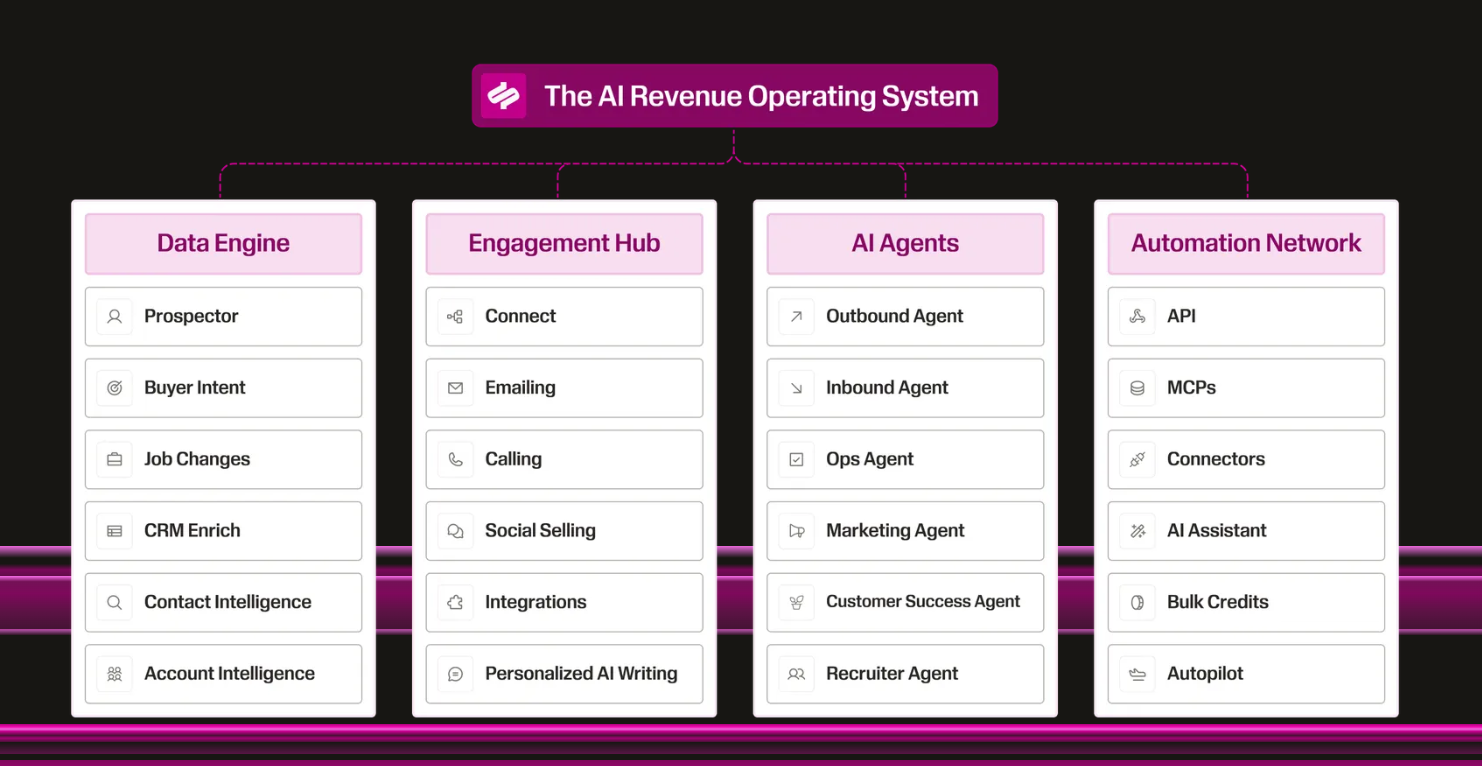
Prospector: searches the Data Engine, which holds 1.6B+ verified business emails and 448M+ phone numbers with 100+ data points per profile. The Chrome extension finds contacts on any website.
Buyer Intent and Job Changes: flags prospects with buying intent and tracks customers who move to a new company, along with their new contact details.
Connect: email, calling, and task lists inside Seamless.AI, now part of every plan, including Free.
AI Agents: six agents for Outbound, Inbound, Ops, Marketing, Customer Success, and Recruiting, each built for a single job such as signal-based outbound or CRM cleanup.
Automation Network: the AI Assistant, MCPs, Connectors, API, Bulk Credits, and Autopilot, plus integrations with 6,000+ tools such as Salesforce, HubSpot, Salesloft, Zoho, Pipedrive, and Microsoft Dynamics.
Seamless.AI pricing
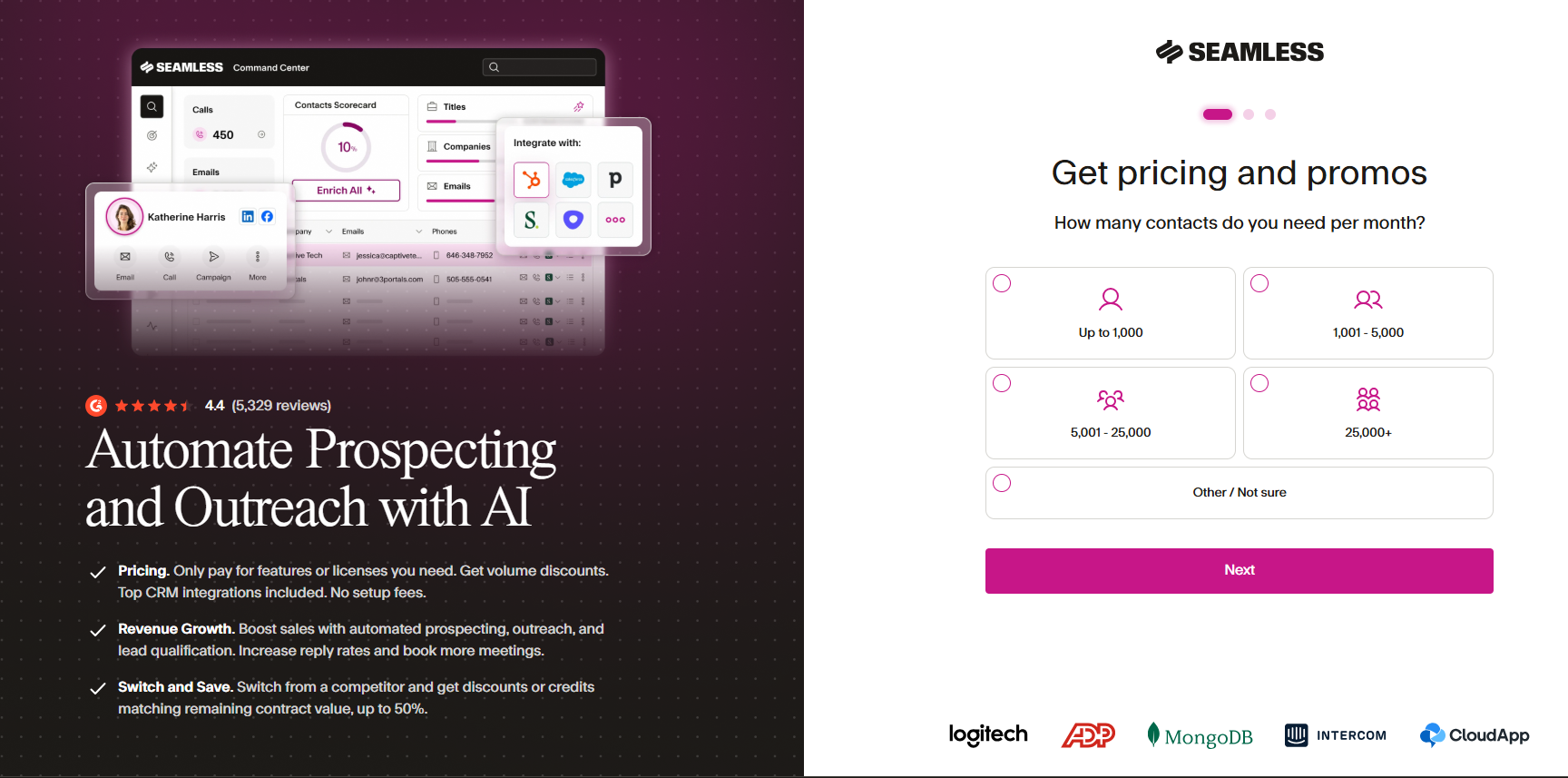
Seamless.AI lists a price only for the free plan. Pro and Enterprise go through sales.
Free: $0 for one user and 50 credits, covering email addresses, cell phones, the real-time search engine, export download, and premium integrations.
Pro: quoted per user, with unlimited exports and annual credit packages from 10,000 credits a year. A free admin seat, advanced org management, and priority support are included.
Enterprise: custom packages for unlimited users, with a dedicated success manager, quarterly business reviews, and phone support.
Seamless.AI pros and cons
✅ The free plan includes the real-time search engine, so results can be tested with no sales call.
✅ Email, calling, and tasks through Connect come at no extra cost on every plan.
✅ With Credit Back Protection, an invalid email returns its credit automatically.
❌ Pro and Enterprise pricing requires a quote.
❌ Several tools, including Buyer Intent Data and Autopilot, are paid add-ons on top of Pro or Enterprise.
#6: UpLead
Best for: Small sales teams and individual reps who prefer one credit per contact, covering both the email and the mobile direct dial, with credits refunded for bounced data.
Similar to: RocketReach, Seamless.AI.
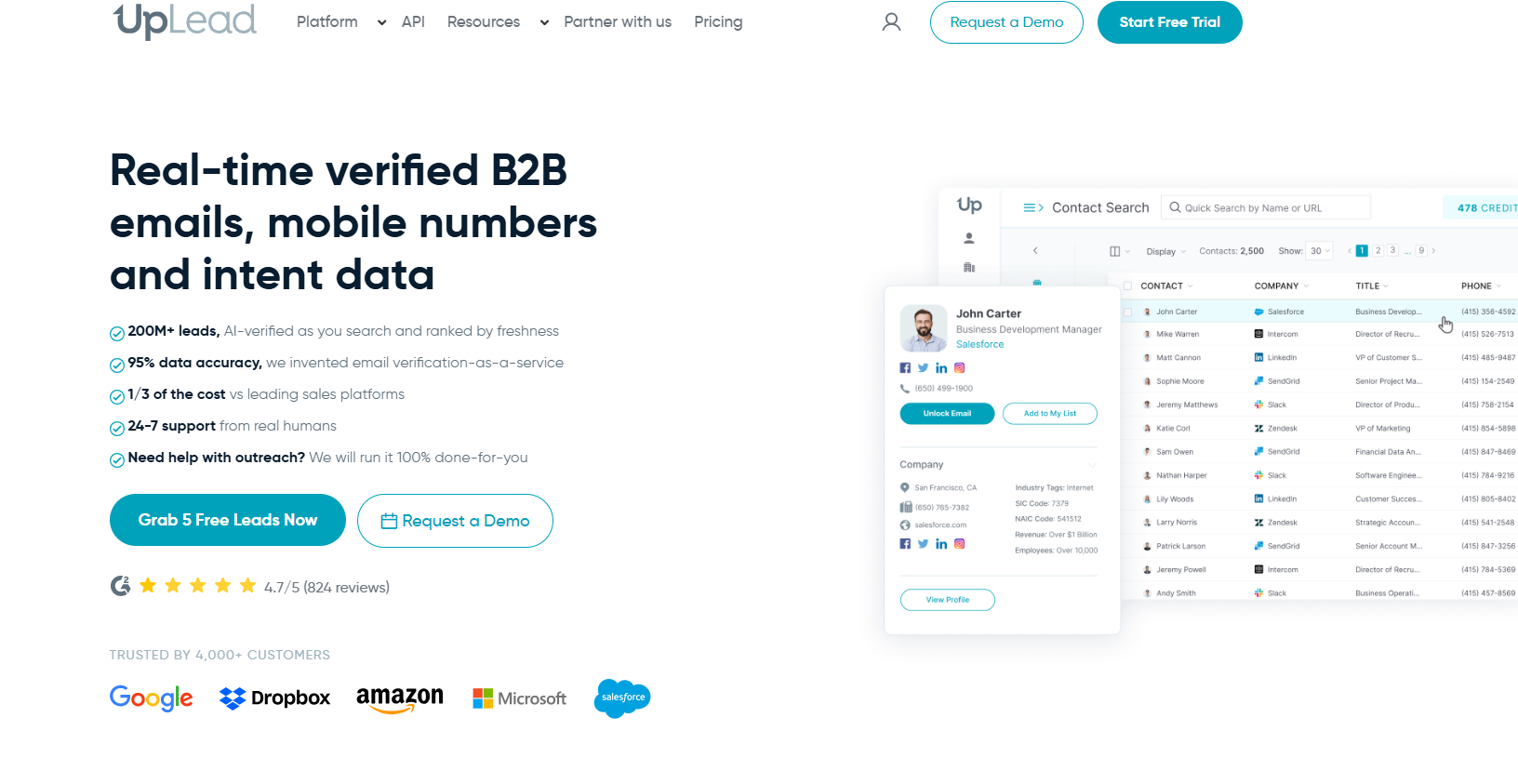
UpLead sells B2B contact data from a database of 200M+ leads, which AI verifies at search time and sorts by freshness.
According to UpLead, that data is backed by a 95%+ accuracy guarantee, pairing real-time email verification with AI validation and human QA.
UpLead features
Prospector: 50+ search filters for building lists of contacts and companies that match your ICP, plus Bulk Lookup for large batches of leads.
Email Verification: emails are checked in real time each time you export leads.
Mobile Direct Dials and Technographics: mobile and direct dial numbers for prospects, alongside 16K+ technology data points showing which tools a company uses.
Intent Data: companies actively researching solutions like yours, available on the Professional plan.
Data Enrichment, API, and integrations: real-time enrichment synced to your CRM and the UpLead API. Native integrations cover Salesforce, HubSpot, Zoho, Pipedrive, Microsoft Dynamics 365, Outreach, and SalesLoft, and Zapier connects 1,500+ more apps.
UpLead pricing
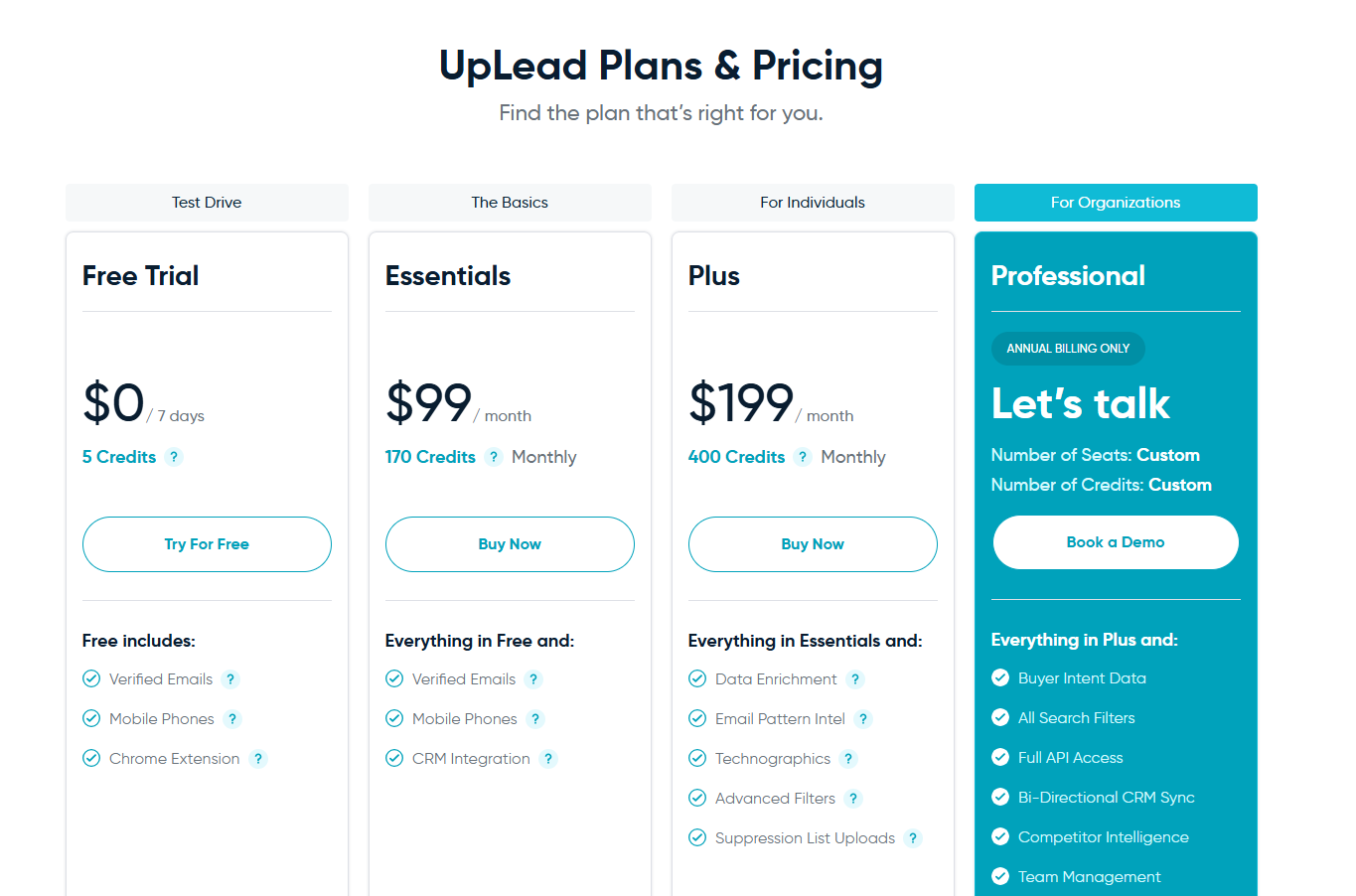
UpLead lists two monthly plans and an annual Professional plan, and new accounts can begin with a seven-day free trial.
Free Trial: $0 for seven days, with five credits, verified emails, mobile phones, and the Chrome extension.
Essentials: $99/month, with 170 credits per month, one user, CRM integration, and extra credits at $0.60 each.
Plus: $199/month, with 400 credits per month, one user, data enrichment, email pattern intel, technographics, advanced filters, suppression list uploads, and extra credits at $0.50 each.
Professional: annual billing only, with custom seats and credits, buyer intent data, all search filters, full API access, bi-directional CRM sync, competitor intelligence, team management, a dedicated success manager, an onboarding specialist, and priority phone support.
UpLead pros and cons
✅ A single credit covers both a contact's email and mobile direct dial.
✅ Friendly Credits returns credits when a contact bounces or the data turns out poor.
✅ Monthly plans carry no contract and can be upgraded or downgraded at any time.
❌ Essentials and Plus each include one user.
❌ Buyer intent data, full API access, and bi-directional CRM sync are reserved for Professional, which is billed annually.
#7: Saleshandy
Best for: Founders, SDRs, and lead-gen agencies who want cold email and lead data in the same platform.
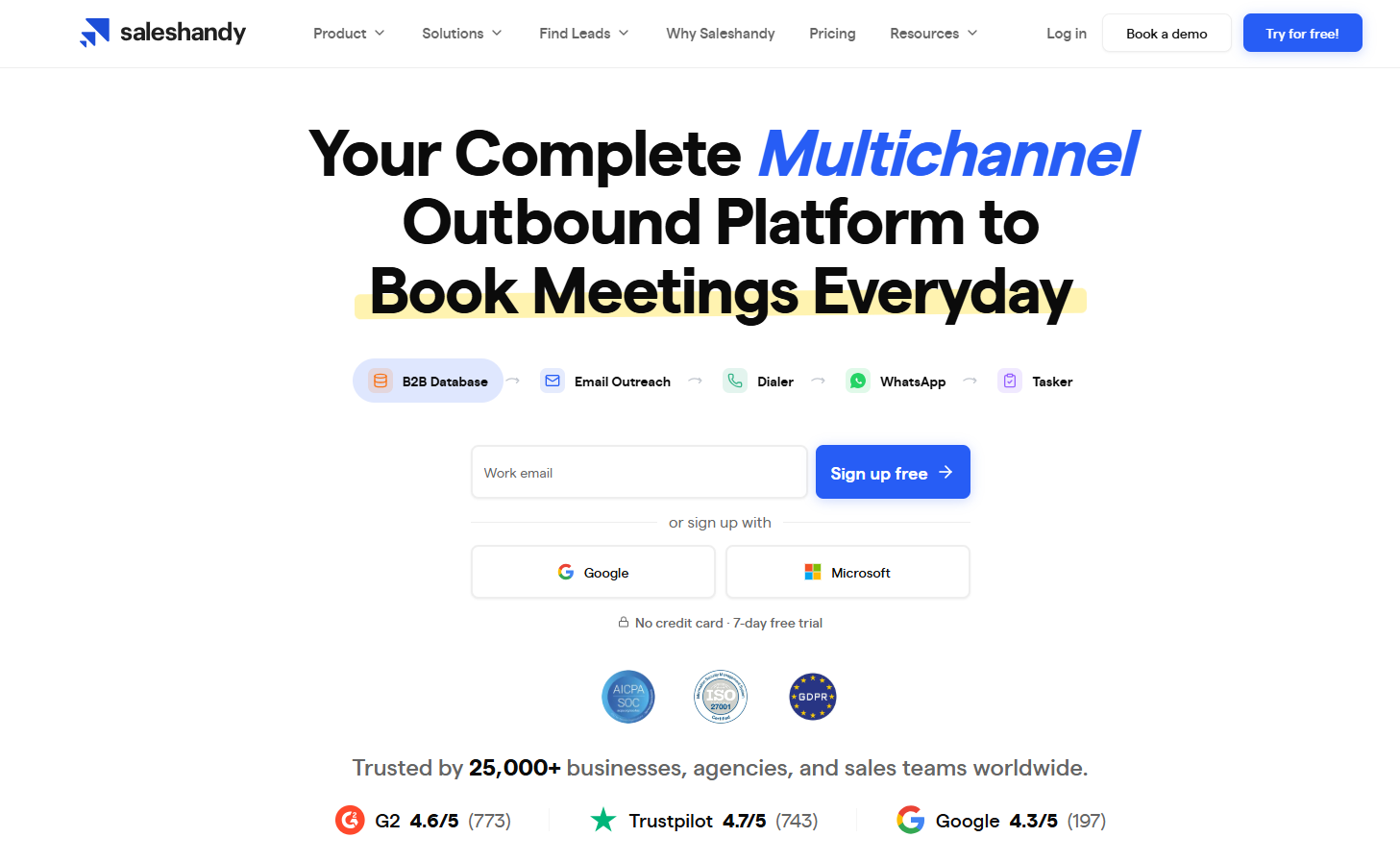
Saleshandy combines a B2B lead database with multichannel outbound sequences.
The database covers 852M+ contacts and 42M+ companies, which you can filter by 50+ buying signals before moving leads into a sequence.
Saleshandy features
Lead Finder with waterfall enrichment: each work email is checked against Saleshandy, Prospeo, RocketReach, Findymail, Enrich.so, and Scalelist, and ZeroBounce and BounceBan verify catch-all addresses. AI natural language search works alongside 40 to 70+ filters.
Multichannel sequences: email steps mixed with calls, WhatsApp messages, LinkedIn actions, and custom tasks. Subsequences can trigger on prospect behavior, and AI can write the copy.
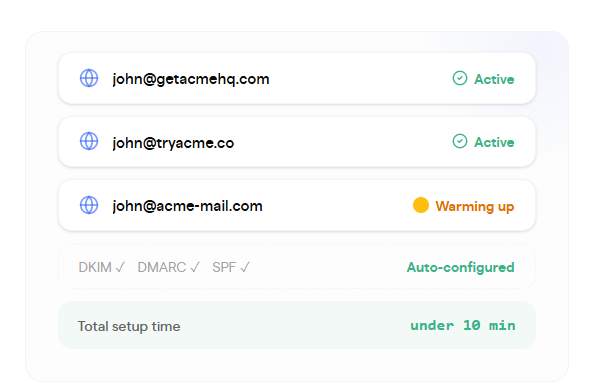
Email infrastructure and deliverability suite: domains and mailboxes bought inside Saleshandy come with SPF, DKIM, and DMARC already set up. Warm-up and sender rotation are unlimited, and inbox placement testing is an add-on.
Unified Inbox and Saleshandy CRM: one inbox collects replies from every connected mailbox and includes a deal pipeline. MCP and CLI access are also available.
Saleshandy pricing
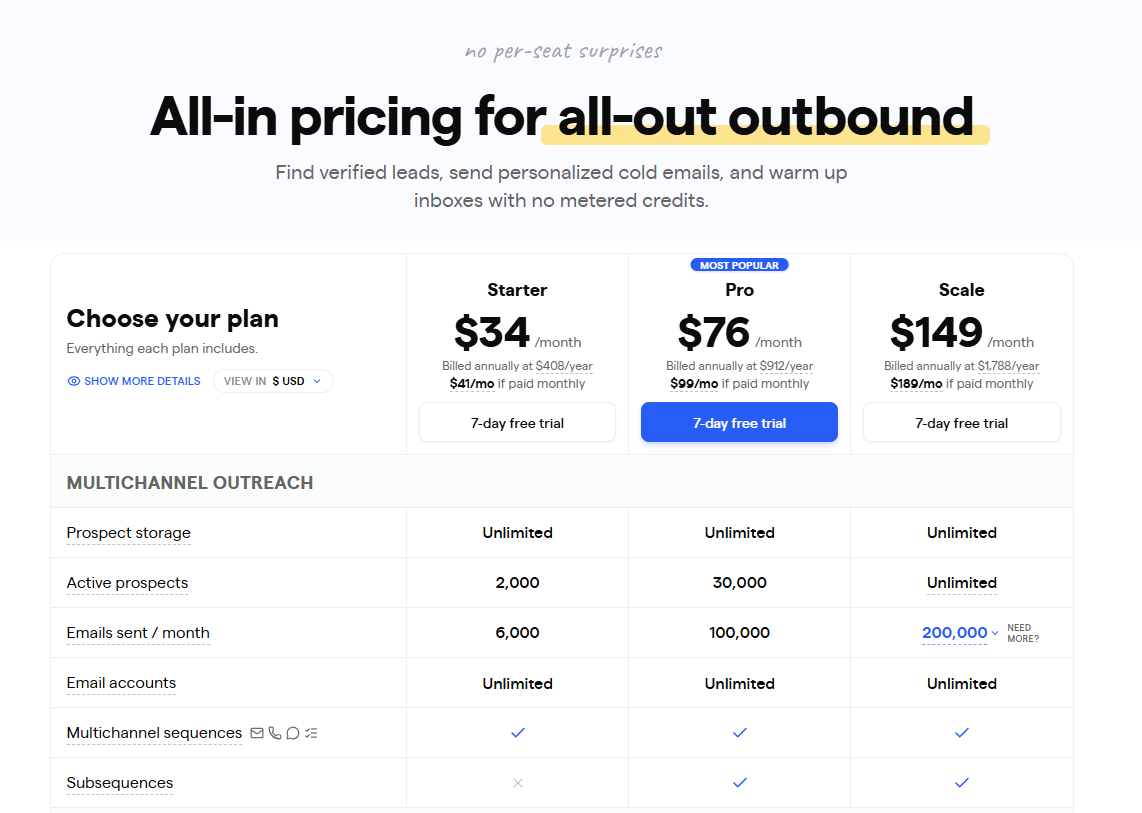
Saleshandy's three paid plans each come with a seven-day free trial, and annual billing brings the entry price down to $34/month.
Starter: $34/month on annual billing or $41 monthly, including 1,500 Lead Finder credits a month, one user, 6,000 emails a month, and 2,000 active prospects.
Pro: $76/month on annual billing or $99 monthly, for 4,000 credits a month, 10 users, 100,000 emails a month, and 30,000 active prospects.
Scale: $149/month on annual billing or $189 monthly, for 8,000 credits a month and 200,000 emails a month, with unlimited users and teams, personalized onboarding, and a dedicated account manager.
Enterprise: custom pricing that includes SSO, whitelabel for agencies, and sending and data volumes sized to your pipeline.
Saleshandy pros and cons
✅ Each email goes through several providers in the waterfall, and you're charged only for a verified result.
✅ Unlimited email accounts and warm-up are included on every plan.
✅ Lead data, sequences, and sending infrastructure come in one subscription.
❌ Adding a second user means moving up from Starter to Pro.
❌ Domains and mailboxes are billed separately from the plan.
#8: RocketReach
Best for: Individual reps, recruiters, and small teams who already know who they want to reach and need that person's email or phone number.
RocketReach is a lookup tool that returns verified contact details for any person or company you search by name.
Its database covers 700 million professionals across 60 million companies, and emails and phone numbers are verified on demand at a stated 98% accuracy.
RocketReach features
Contact and company search: 50+ filters for work history, industry, and location. Technographics, news, and org charts start on Pro.
Browser extension: shows a prospect's email and phone on whatever page you're viewing, so you don't have to open the RocketReach app.
Messages and Autopilot: Messages sends emails with automatic follow-ups and an AI writer. Autopilot jobs run in the background, finding and contacting new prospects.
Integrations and Contact Data API: exports go to Salesforce, HubSpot, Outreach, Salesloft, and Bullhorn from Pro, and the Contact Data API enriches records from a pool of 4.5B records.
RocketReach pricing
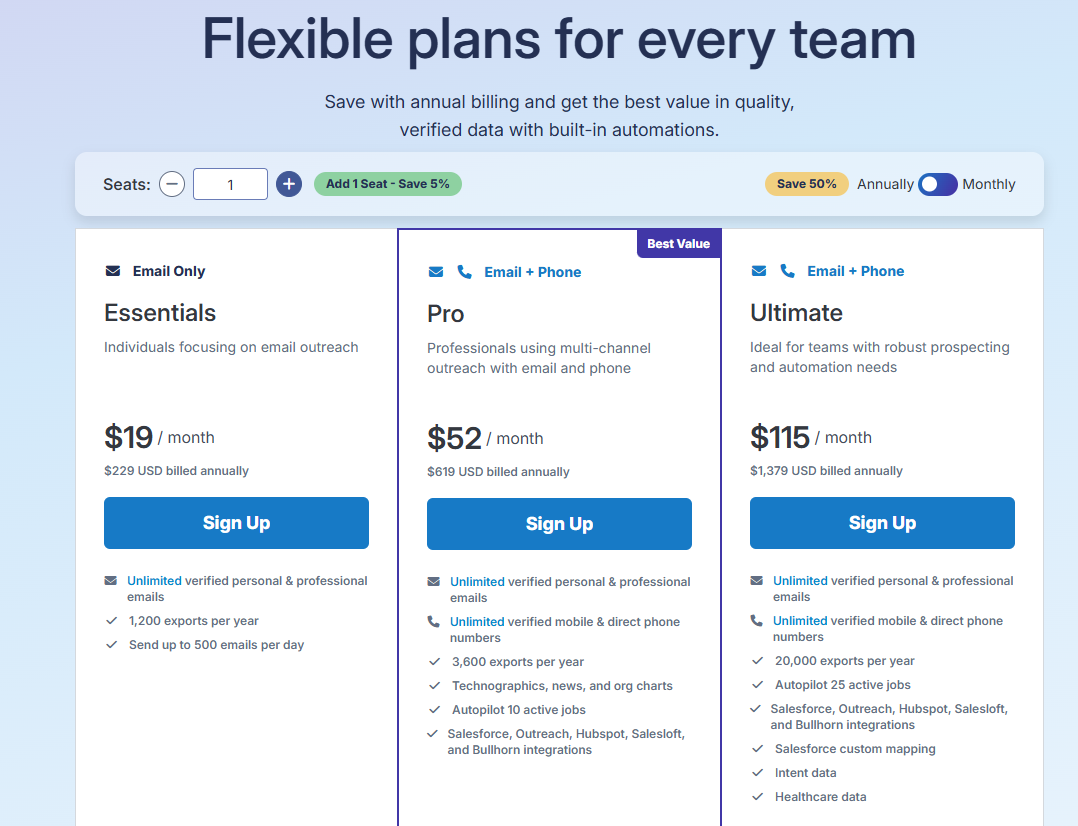
All three RocketReach plans are priced per user, and paying annually saves up to 50% compared with monthly billing. The entry plan is $19/month on annual billing.
Essentials (email only): $19/month, or $229 a year, for unlimited verified work and personal emails, 1,200 exports a year, and up to 500 emails sent per day.
Pro (email and phone): $52/month, or $619 a year. Pro adds unlimited verified mobile numbers and direct dials, 3,600 exports a year, technographics, news, org charts, 10 active Autopilot jobs, and CRM integrations.
Ultimate: $115/month, or $1,379 a year, for 20,000 exports a year, 25 active Autopilot jobs, Salesforce custom mapping, intent data, and healthcare data.
Custom team plans: from $6,000 a year, with pooled credits, company and custom exports, higher API limits, and a dedicated account manager.
RocketReach pros and cons
✅ Prices for monthly and annual billing are both public.
✅ On annual plans, verified lookups have no limit, and only exports are capped.
✅ Every plan includes Messages and Autopilot for email outreach and automated prospecting.
❌ Phone numbers start on Pro, since Essentials returns emails only.
❌ Intent data and Salesforce custom mapping are Ultimate-only features.
#9: Hunter
Best for: Finding and verifying work emails, then sending cold email sequences from the same platform, for founders, marketers, and agencies.
Similar to: Saleshandy, RocketReach.
Hunter is an all-in-one email outreach platform, used by 7M+ people, for finding and verifying the email addresses of decision-makers.
Leads can then be enriched and added to automated Sequences inside Hunter.
Hunter features
Discover, Domain Search, and Email Finder: Discover builds target lists from Hunter's B2B company database using buying signals. Domain Search shows who to contact at a company from its name or website, and Email Finder looks up an address from a person's name.
Email Verifier and Lead Enrichment: verify lists before a campaign goes out and fill in missing company details for each contact, with auto-verification on paid plans.
Sequences and Inbox Protection: send automated, A/B-tested email sequences from your own inbox. Inbox Protection warms the inbox and guards against bounce rates above 2%, and managed email accounts can be bought inside Hunter.
MCP, API, and integrations: a remote MCP server for AI apps, the Chrome extension, a Google Sheets add-on, CRM sync with HubSpot, Zoho, Salesforce, and Pipedrive, and 5,000+ endpoints through Zapier.
Hunter pricing
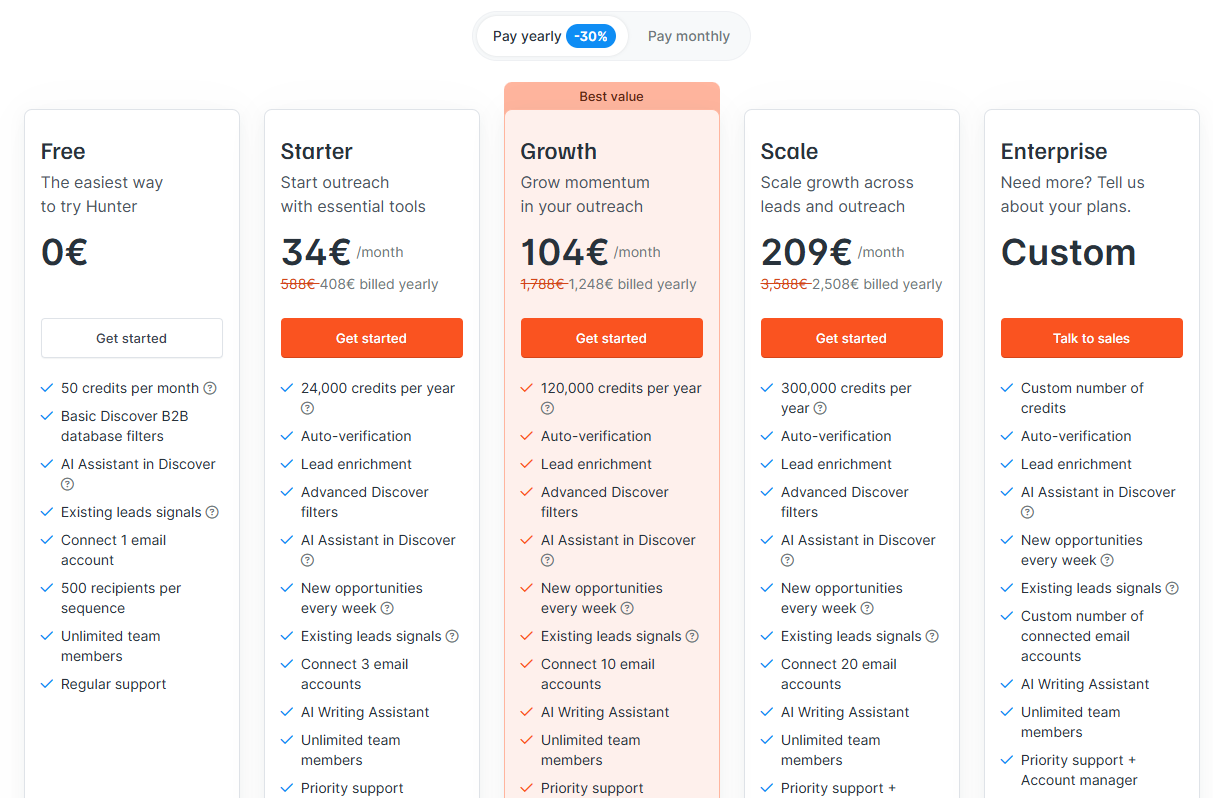
Paid Hunter outreach plans start at €34/month on yearly billing, 30% less than paying monthly, and a free plan is available. Hunter lists these prices in euros.
Free: €0, with 50 credits per month, basic Discover filters, the AI Assistant in Discover, one connected email account, 500 recipients per sequence, and unlimited team members.
Starter: €34/month, billed yearly at €408, with 24,000 credits per year, auto-verification, lead enrichment, advanced Discover filters, three connected email accounts, the AI Writing Assistant, and priority support.
Growth: €104/month, billed yearly at €1,248, with 120,000 credits per year and 10 connected email accounts.
Scale: €209/month, billed yearly at €2,508, with 300,000 credits per year, 20 connected email accounts, and an account manager.
Enterprise: custom credits and connected email accounts, with priority support and an account manager.
Hunter pros and cons
✅ Unlimited team members come with every plan, Free included.
✅ Paid plans verify emails automatically.
✅ The Data Platform sells API credits pay-as-you-go, with no subscription.
❌ Hunter's plans cover email finding and verification, with no phone or mobile number reveals listed.
❌ Inbox Protection and managed email accounts cost extra on top of the plan.
#10: LeadDelta
Best for: LinkedIn-first founders, sellers, and agencies that turn their own and their team's LinkedIn connections into pipeline.
Similar to: Saleshandy, Hunter.
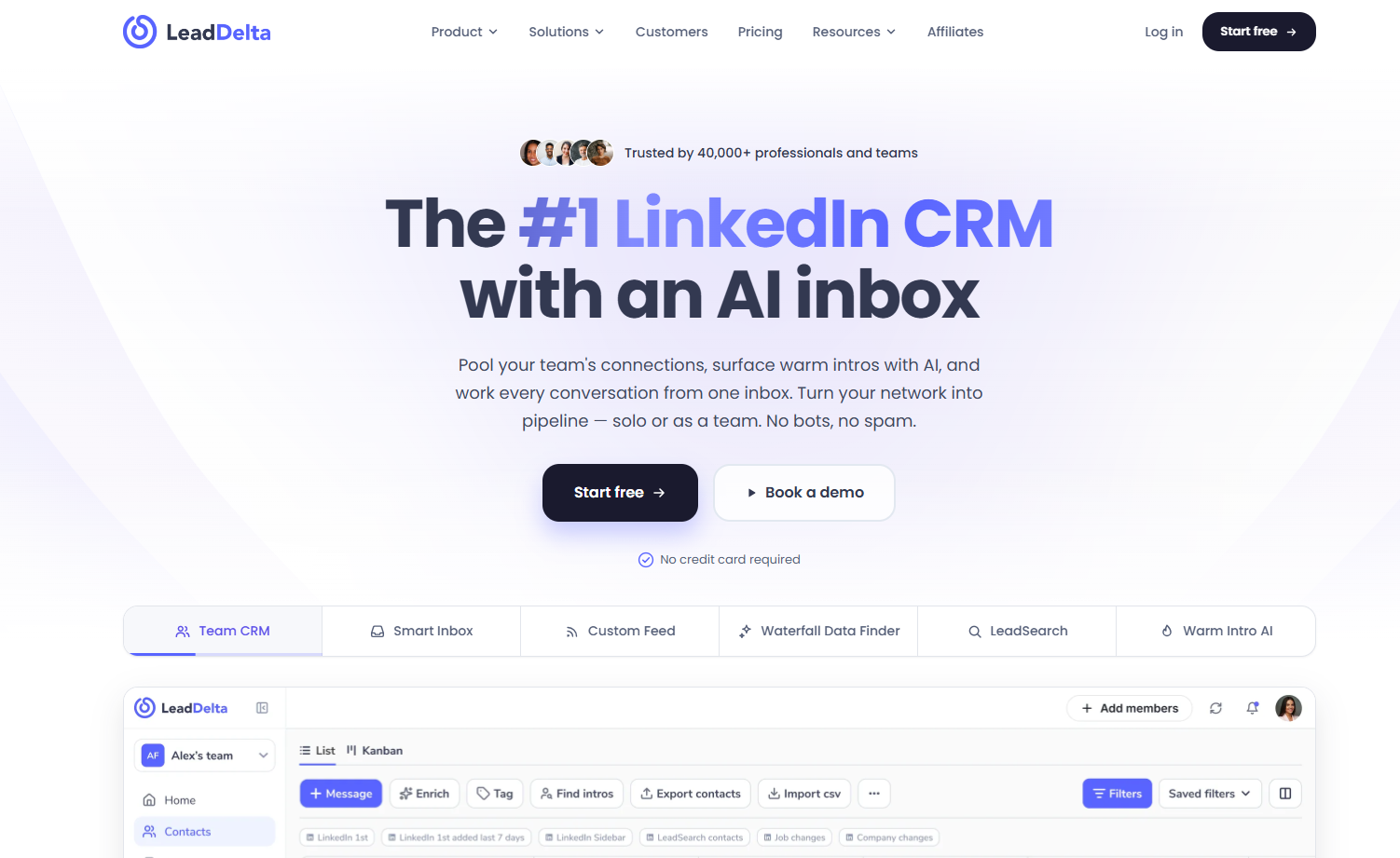
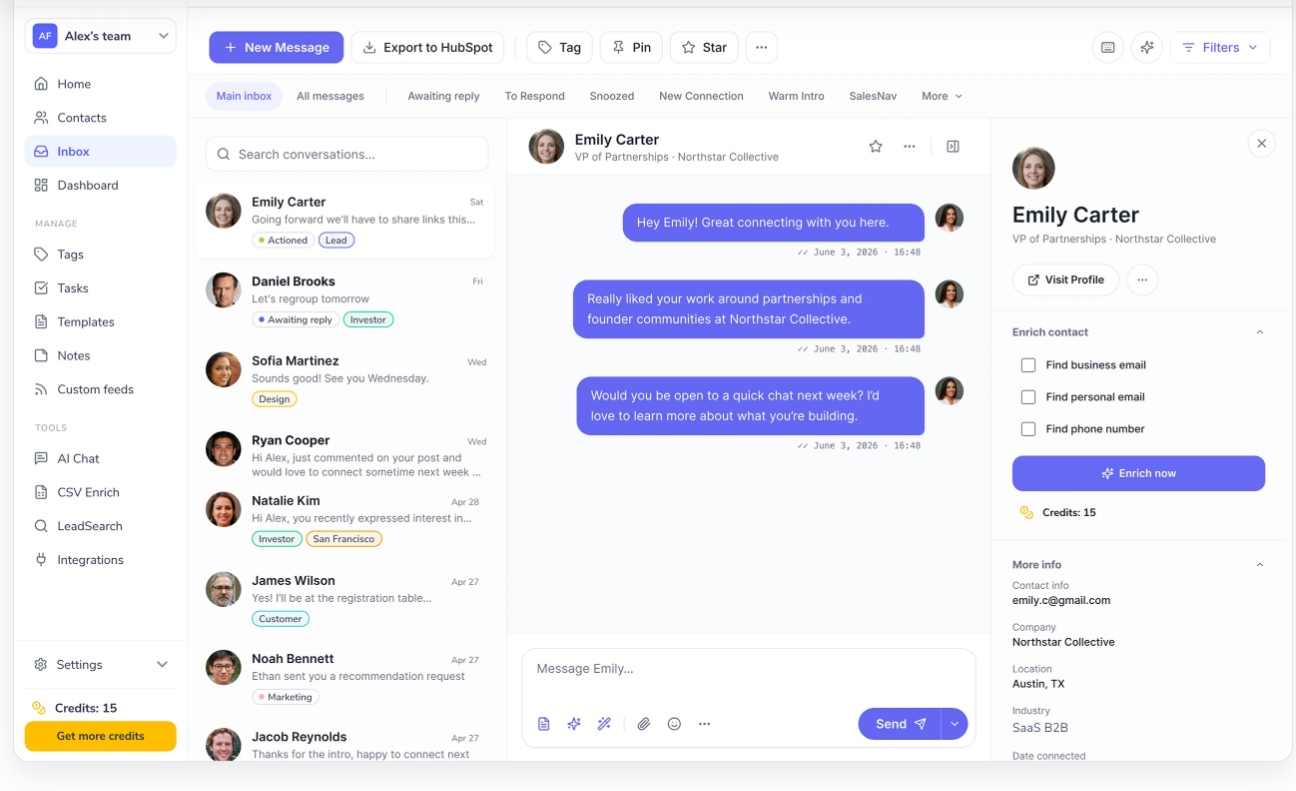
Built as a LinkedIn CRM with an AI inbox, LeadDelta is used by 40,000+ professionals and teams.
Your LinkedIn connections, and your team's, sync into one shared CRM, where LeadDelta finds verified emails and phone numbers for the people in it.
LeadDelta features
Team CRM and Shared Network: bring in your LinkedIn connections and your teammates', then organize the combined network with lists, tags, notes, tasks, and reminders.
Smart Inbox: your LinkedIn conversations, notes, and follow-ups gathered in one inbox, where AI drafts replies and flags the threads that need attention.
Waterfall Data Finder and LeadSearch: find verified business and personal emails and phone numbers on credits. On the Business plan, LeadSearch adds new decision-makers from a pool of 500M people.
Warm Intro AI and Network Intelligence AI-chat: Warm Intro AI finds mutual contacts and warm paths into a prospect so you can request an introduction, and Network Intelligence AI-chat answers questions about the workspace's connections, notes, and tags. Both come with the Business plan.
Integrations: HubSpot sync, Zapier, CSV import and export, and API/MCP access for Claude, ChatGPT, and Perplexity from the Pro plan.
LeadDelta pricing
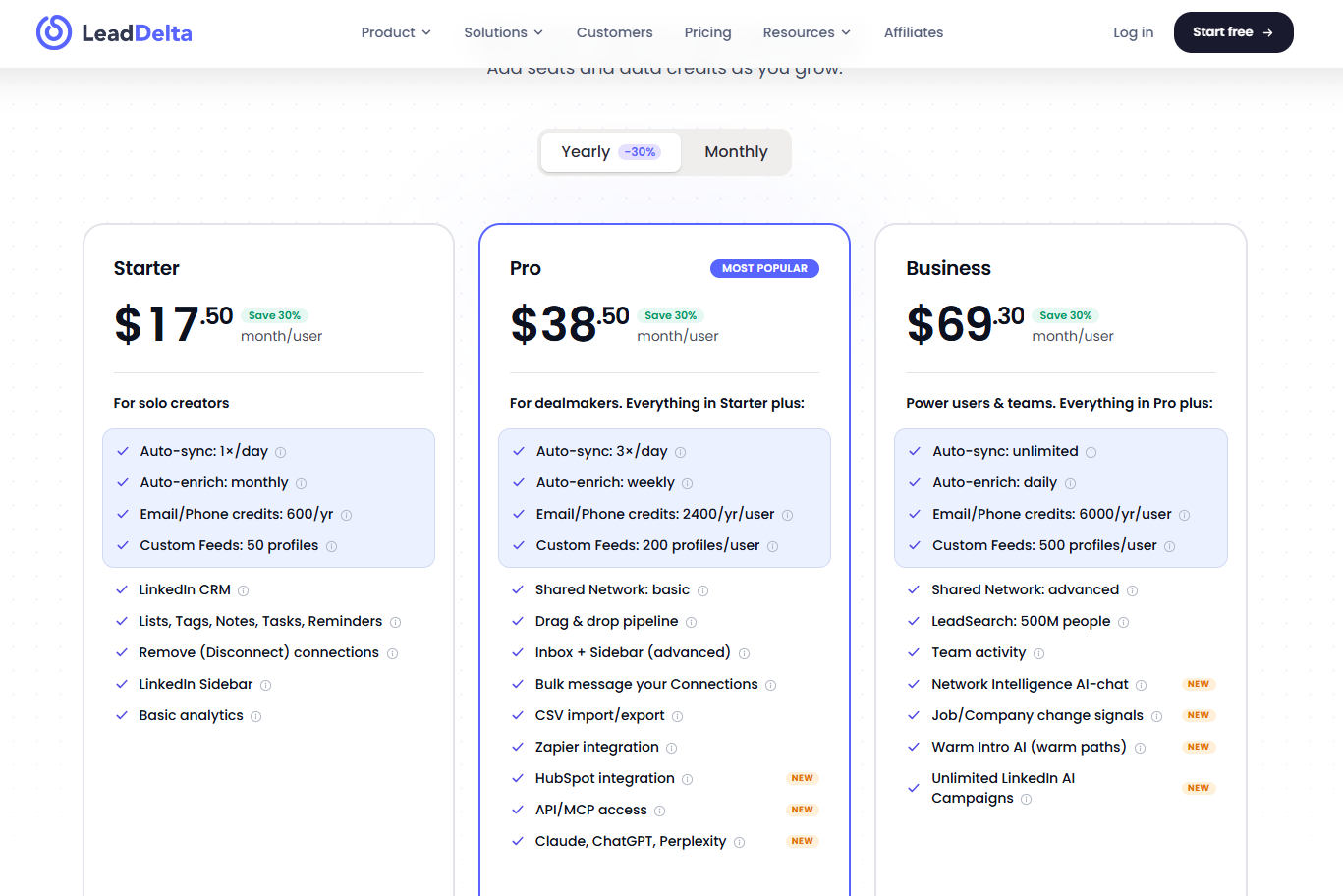
LeadDelta charges per user, from $17.50/user/month on yearly billing, a 30% saving. Starter, Pro, and Business each come with a seven-day free trial and no credit card required.
Starter: $17.50/user/month, billed yearly, with 600 email and phone credits per year, auto-sync once a day, monthly auto-enrich, Custom Feeds for 50 profiles, the LinkedIn CRM, and the LinkedIn Sidebar.
Pro: $38.50/user/month, billed yearly, with 2,400 credits per user per year, auto-sync three times a day, weekly auto-enrich, basic Shared Network, a drag-and-drop pipeline, the advanced Inbox and Sidebar, bulk messaging in batches of 25, and HubSpot, Zapier, and API/MCP access.
Business: $69.30/user/month, billed yearly, with 6,000 credits per user per year, unlimited auto-sync, daily auto-enrich, advanced Shared Network, LeadSearch across 500M people, team activity, job and company change signals, Warm Intro AI, Network Intelligence AI-chat, and unlimited LinkedIn AI Campaigns.
Enterprise: customized plans for organizations of 100 to 10,000 people, with SSO (SAML and OIDC), custom integrations, custom onboarding, and dedicated Customer Success.
Credits are weighted by contact type: 10 credits buy 10 verified business emails, three verified personal emails, or one verified phone number.
LeadDelta pros and cons
✅ Your team's combined LinkedIn network is searchable from one shared CRM.
✅ Warm Intro AI shows which teammate can introduce you to a prospect.
✅ Auto-enrich refreshes titles, companies, and locations on a schedule without using credits.
❌ One verified phone number uses 10 credits, the same as 10 business emails.
❌ Prospecting outside your network with LeadSearch, along with Warm Intro AI, needs the Business plan.
Start with 500 free credits on Meet Rocco
Lusha is a good fit when verified data needs to flow into your CRM and AI assistants with buying signals attached.
If you'd like each search to run on the live web, Meet Rocco charges per reveal and keeps purchased credits valid for 12 months, with no seat license.
Your 500 free credits cover up to 500 email reveals or 100 phone reveals, with no credit card needed.
Enterprise teams, or anyone who wants a product demo before committing, can get in touch with us.
Disclaimer: This article was last updated on October 9, 2026. Pricing and features come from each vendor's website unless a third-party source is named. If anything here is out of date, contact us, and we'll check it. All product names are trademarks of their respective owners.
Frequently asked questions
What is the best Lusha alternative?
Meet Rocco is the best Lusha alternative for outbound teams and agencies. It finds verified emails and mobile numbers through a live web search and charges per reveal, using self-serve credits that stay valid for 12 months.
For intent data and signals at enterprise scale, the usual shortlist is ZoomInfo and Cognism.
What is the cheapest Lusha alternative?
LeadDelta Starter has the lowest yearly list price at $17.50/user/month, though its data is built around your LinkedIn network.
RocketReach Essentials comes next at $19/month on annual billing, for emails only.
Without an annual commitment, Meet Rocco's Starter costs $25/month on monthly billing and includes phone reveals. Meet Rocco's pay-as-you-go packs start at 50 credits, from as low as $2, with no subscription.
Apollo.io, Seamless.AI, and Hunter also offer free plans with limited credits.
What is the best Lusha alternative for agencies?
Meet Rocco is the best Lusha alternative for lead-gen and outbound agencies.
Live web search reaches niche segments and newer companies across different client ICPs, and credits are bought per reveal, so data costs can follow client volume without a seat license.
Agencies that also send campaigns on behalf of clients can look at Saleshandy, whose Enterprise plan includes whitelabel for agencies.
What is the best Lusha alternative for founders and small teams?
For founders and small teams, Meet Rocco is the best Lusha alternative.
Every account starts with 500 free credits and no credit card, and the Starter plan costs $25/month on monthly billing with phone reveals included.
Founders who mainly need work emails and plan to send cold email themselves can start on Hunter's free plan, which includes 50 credits a month and Sequences.
Which Lusha alternative is best for RevOps teams enriching a CRM?
Cognism and ZoomInfo are the closest fits for RevOps teams that need CRM records enriched and kept current.
Cognism's CRM Enrichment runs alongside its prospecting packages or on its own and charges another credit only when key details change, such as a job move. ZoomInfo enriches and cleans contact and company records across connected systems, including tools outside the CRM.
Meet Rocco has no native CRM sync and moves lists through CSV or PDF export, so it fits list building better than ongoing CRM enrichment.