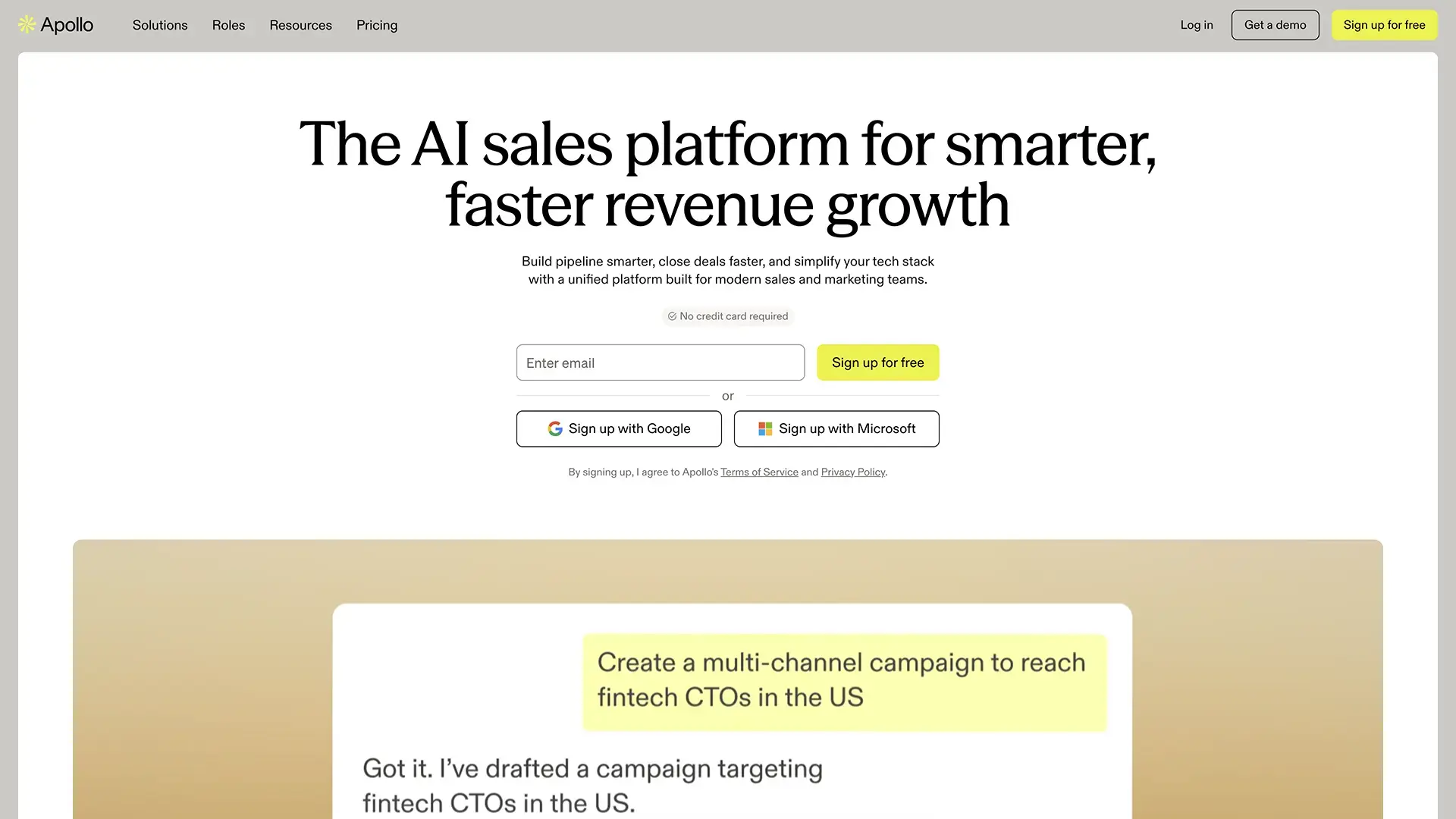
Apollo.io is a solid choice if you want one subscription that covers a large contact database, AI-assisted search, and built-in outreach sequencing, and you're comfortable with per-seat pricing that scales with team size. If you mainly need fresh leads and contact reveals without committing to a per-seat platform, Meet Rocco's credit-based model is worth a look first.
The difference is really about operating model, not just price. Apollo bundles database access with a full engagement suite (sequencing, dialling, reporting) and charges per seat. Meet Rocco unbundles the sourcing step: pay in credits, subscription or pay-as-you-go, and bring your own outreach tools. Choose based on whether you want one all-in-one platform or a lighter sourcing layer alongside your existing stack.
Apollo.io markets itself as an all-in-one sales intelligence and engagement platform, built around a large B2B contact database plus native sequencing and dialling. It's one of the most widely adopted tools in this category.
This comparison looks at Apollo's publicly listed pricing, plan structure, and the data-accuracy concerns raised across independent reviews, then sets it against Meet Rocco, a credit-based, real-time lead sourcing tool. The goal is to help you decide which operating model fits, not to declare a universal winner. All figures are drawn from each company's own pricing page and cross-checked against third-party pricing breakdowns.

Apollo.io markets itself as an all-in-one sales intelligence and engagement platform, built around a large B2B contact database plus native sequencing and dialling. It's one of the most widely adopted tools in this category.
This comparison looks at Apollo's publicly listed pricing, plan structure, and the data-accuracy concerns raised across independent reviews, then sets it against Meet Rocco, a credit-based, real-time lead sourcing tool. The goal is to help you decide which operating model fits, not to declare a universal winner. All figures are drawn from each company's own pricing page and cross-checked against third-party pricing breakdowns; where a claim comes from a vendor's own marketing rather than an independent test, that's flagged.
Apollo.io is a cloud-based sales intelligence and engagement platform. It combines a contact database (reported at 275M+ contacts) with AI-assisted search, email sequencing, a dialler, and reporting, all inside one subscription. It targets sales teams and SDR orgs that want prospecting and outreach in a single tool rather than stitched together from separate products.
Pricing runs per seat across four tiers, and access to features like advanced reporting, SSO, and higher mobile-credit allowances is gated by tier, so the entry price doesn't fully reflect what a scaling team ends up paying.
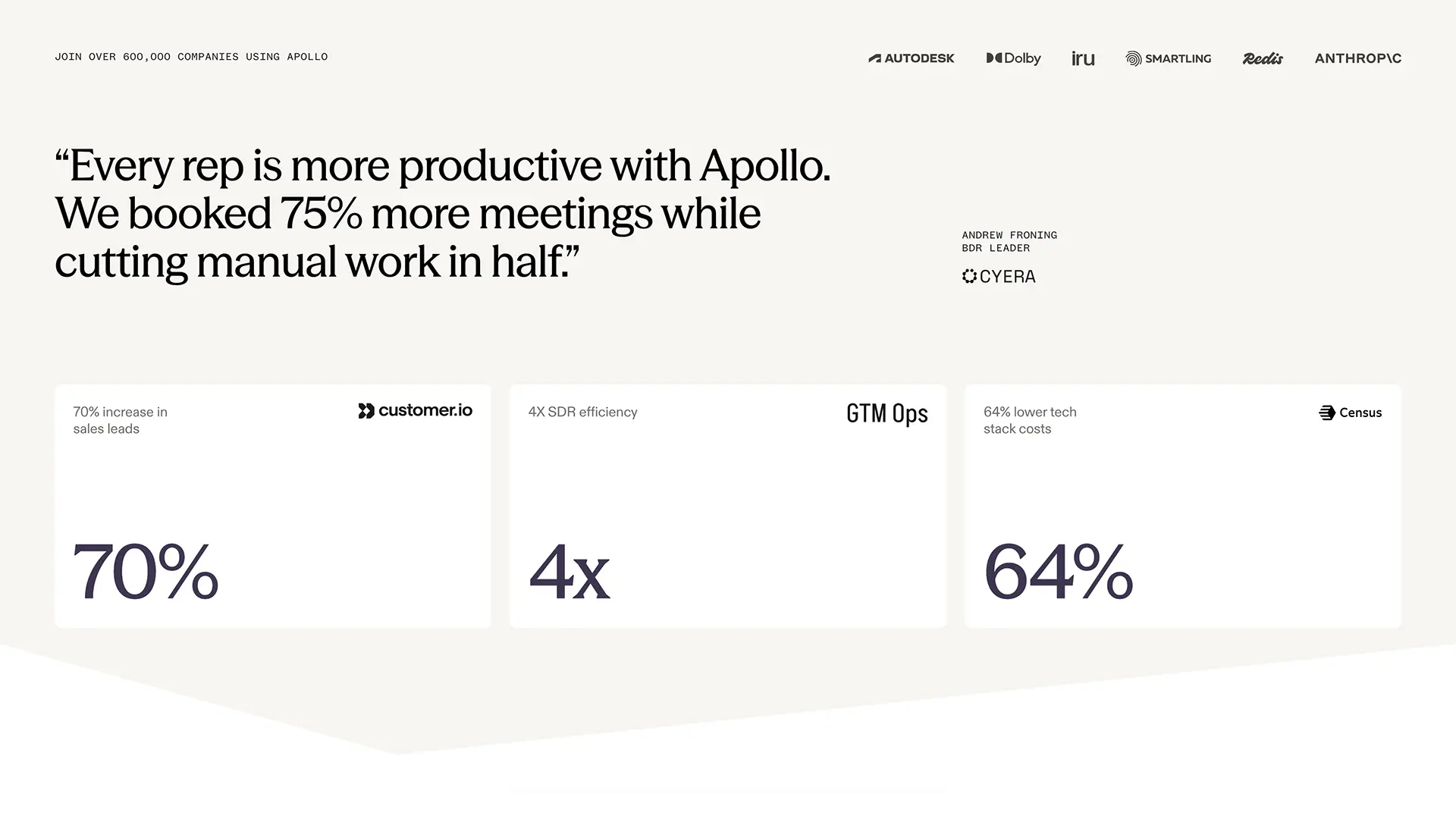
Apollo's core value is its stored database, searchable with filters for role, seniority, industry, location, and company size. Records are enriched and machine-verified, and export/CRM sync draws on a separate export-credit pool.
Built-in email sequencing, a dialler, and reporting sit inside the same subscription, which is the main reason teams choose Apollo over a sourcing-only tool: prospecting and outreach happen without leaving the platform.
Apollo separates data/search credits, mobile/phone credits, and export credits by plan. Multiple independent pricing breakdowns note these typically reset monthly without rollover, which can create pressure to use credits before they're lost, or unexpected overage costs for teams that don't track usage closely.
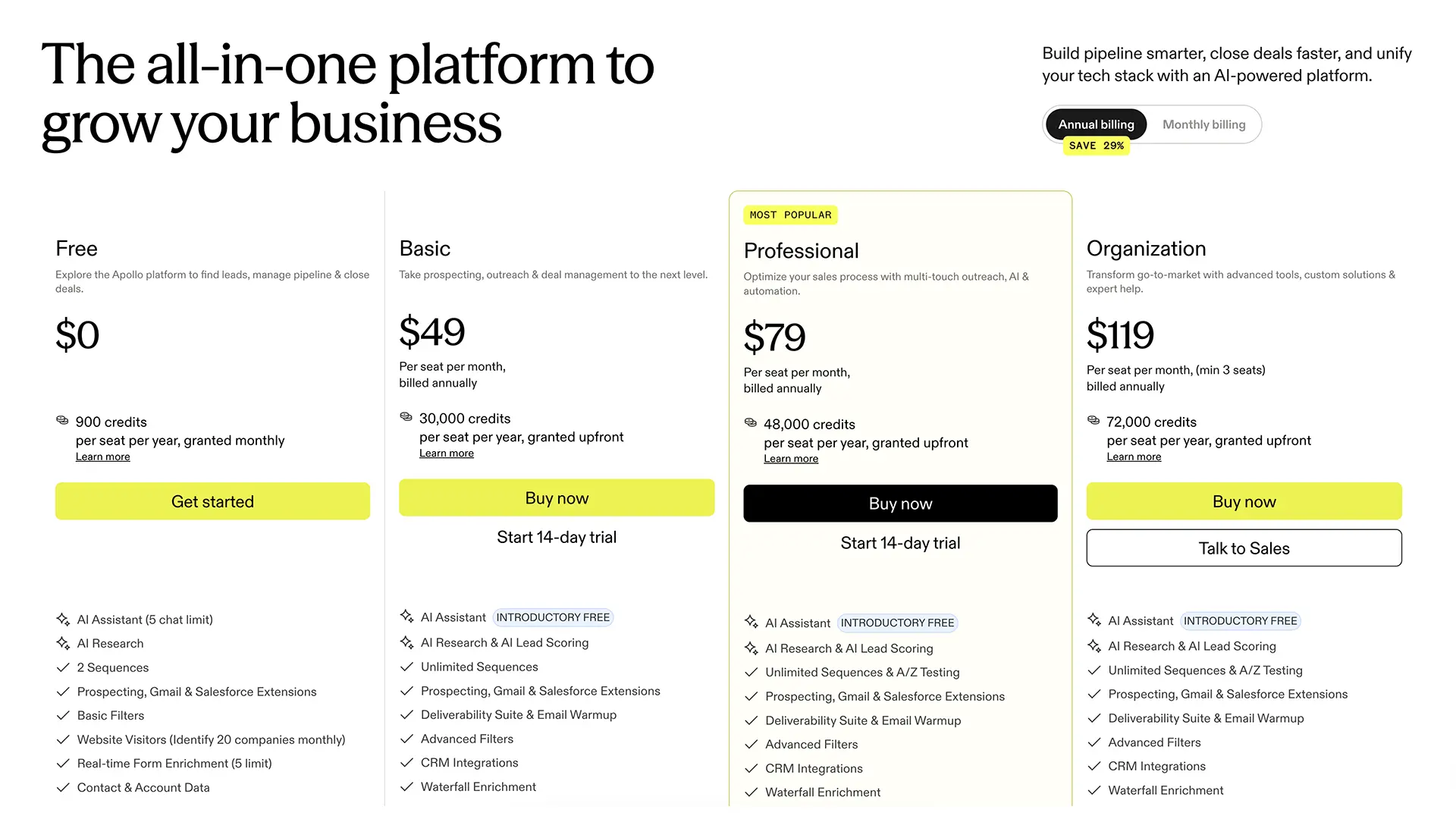
Apollo.io lists four tiers, priced per seat, with separate monthly and annual billing options. Credits are granted per month on monthly billing, or as a lump sum upfront on annual billing (except the Free plan, which grants credits monthly either way):
Annual billing brings a meaningful discount across every paid tier, roughly 25-33% cheaper per seat than paying monthly (Basic: $49 vs $65, Professional: $79 vs $99, Organization: $119 vs $149). The trade-off is committing to a year upfront. The per-seat multiplier is the bigger cost driver reviewers flag regardless of billing cycle: a 10-person team on annual Basic runs close to $490/month, not $49. Compared with this, Meet Rocco's Starter plan ($25/month) or pay-as-you-go option has no seat multiplier, credits roll over, and stay valid for 12 months, though it doesn't include sequencing, dialling, or a CRM the way Apollo does.
Apollo emphasizes machine-verified, large-scale data coverage. Independent reviewers report mixed results, several note lower accuracy specifically on phone/mobile numbers versus general contact data, with resulting bounce rates on email campaigns that some users describe as higher than expected. These are third-party observations, not something independently verified here, and data accuracy can vary by industry, region, and how recently a record was updated.
Meet Rocco's approach is to source contacts by mining the web in real time rather than serving from a stored, periodically refreshed database, which it frames as a way to reduce staleness.
Meet Rocco is purpose-built for sourcing and contact reveals rather than full sequencing and dialling. Teams that already run outreach through a CRM or engagement tool can plug Meet Rocco in purely for lead sourcing, paying only for the reveals they use, without duplicating the cost of a bundled platform.
Apollo.io earns its popularity: a large database, sequencing, and dialling in one subscription is genuinely convenient for teams that want a single tool. The trade-off is per-seat cost that compounds with team size, and a layered credit system that takes some active management to avoid overage or waste.
Meet Rocco takes a different bet: no seat multiplier, credits that roll over for a full year, and a lower entry point, focused specifically on getting fresh leads into your hands without the cost or complexity of a bundled platform. Pair it with whatever outreach tool you already use, or start with the free trial and add a paid plan once you've seen the lead quality for yourself.
Apollo.io can work if you're prepared to lock into per-seat pricing for database access, sequencing, and dialling bundled together. But if you'd rather only pay for the leads you actually need, skip the per-seat multiplier, and keep your credits rolling over instead of resetting, Meet Rocco is built for exactly that. Start with the free trial and see the lead quality for yourself before committing to anything.
This comparison is based on publicly available information from the official websites, documentation, pricing pages, and published feature lists at the time of writing (July 28, 2026). Features, pricing, and product capabilities may change over time. Organizations should evaluate both platforms against their own outreach goals, budget, and workflow requirements before making a purchasing decision.